Hi @hjudge1
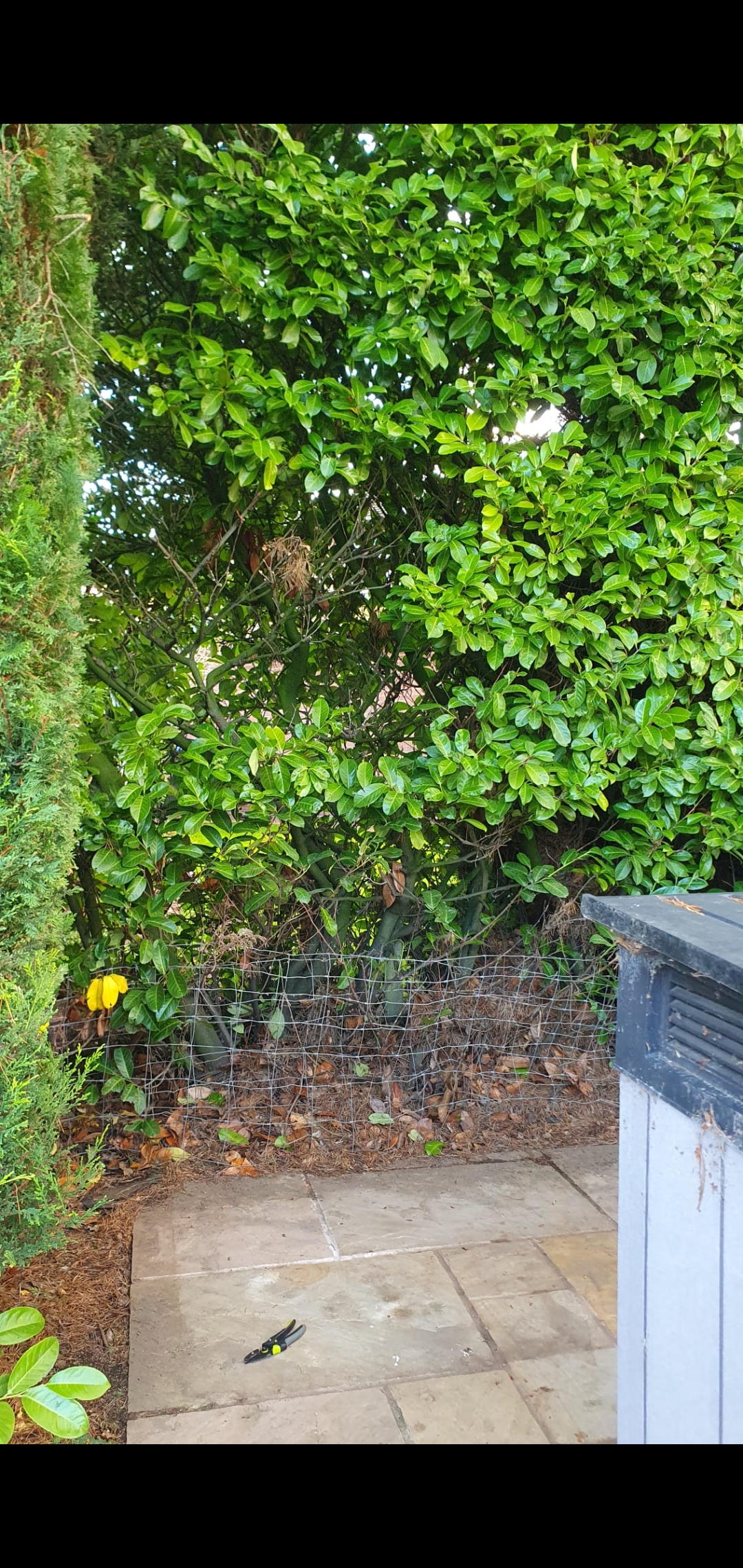
Right, looking at your laurel hedge, I can see what's happening here. That gap in the middle where you've got dieback and those yellowing leaves is telling you something. The pine needles dropping on it won't be helping either, as they can create a bit of a dense mat that stops light and air from getting through to the foliage below. Laurels are pretty bombproof as hedges go, but they do need a helping hand when branches start dying back like this.
The good news is laurels respond brilliantly to hard pruning, so you can definitely save this plant and get it bushing back out again. What I'd recommend is selectively cutting back those dead or dying branches right back to where you find green, healthy wood. Don't be timid about it – you want to cut back to a point where the wood inside is fresh and green, not brown or grey.
This might mean taking quite a bit off, but the laurel will thank you for it by sending out vigorous new growth from those pruning points come spring. The key is being selective rather than just hacking the whole thing back. Work your way through that gap, identifying which branches are properly dead or dying, and remove them cleanly with sharp secateurs or loppers depending on the thickness.
Once you've done that hard pruning to remove the deadwood, the laurel will naturally want to fill in that space with fresh growth. Laurels have dormant buds all along their stems, so when you prune back hard, those buds wake up and produce new shoots. You might also want to give the whole hedge a general tidy up at the same time, taking it back to encourage a denser, more uniform shape overall.
Late winter or early spring is absolutely the best time for this kind of renovation work, just before the growing season kicks in properly. Make sure you clear away those pine needles from around the base as well to improve airflow and let light reach the lower foliage.
https://youtu.be/a6kz7ou_32c
Happy gardening!
Lee Garden Ninja
Further Reading
If you want to get confident with your pruning technique, these guides will help set you up for success:
How to prune garden plants: ultimate beginner pruning guide
How to cut, prune & trim hedges: the ultimate beginner guide
Winter Vs Summer Pruning: what's the difference?
Hi @hjudge1
Right, looking at your laurel hedge, I can see what's happening here. That gap in the middle where you've got dieback and those yellowing leaves is telling you something. The pine needles dropping on it won't be helping either, as they can create a bit of a dense mat that stops light and air from getting through to the foliage below. Laurels are pretty bombproof as hedges go, but they do need a helping hand when branches start dying back like this.
The good news is laurels respond brilliantly to hard pruning, so you can definitely save this plant and get it bushing back out again. What I'd recommend is selectively cutting back those dead or dying branches right back to where you find green, healthy wood. Don't be timid about it – you want to cut back to a point where the wood inside is fresh and green, not brown or grey.
This might mean taking quite a bit off, but the laurel will thank you for it by sending out vigorous new growth from those pruning points come spring. The key is being selective rather than just hacking the whole thing back. Work your way through that gap, identifying which branches are properly dead or dying, and remove them cleanly with sharp secateurs or loppers depending on the thickness.
Once you've done that hard pruning to remove the deadwood, the laurel will naturally want to fill in that space with fresh growth. Laurels have dormant buds all along their stems, so when you prune back hard, those buds wake up and produce new shoots. You might also want to give the whole hedge a general tidy up at the same time, taking it back to encourage a denser, more uniform shape overall.
Late winter or early spring is absolutely the best time for this kind of renovation work, just before the growing season kicks in properly. Make sure you clear away those pine needles from around the base as well to improve airflow and let light reach the lower foliage.
Happy gardening!
Lee Garden Ninja
Further Reading
If you want to get confident with your pruning technique, these guides will help set you up for success:
How to prune garden plants: ultimate beginner pruning guide
How to cut, prune & trim hedges: the ultimate beginner guide
Winter Vs Summer Pruning: what's the difference?

 Lee Burkhill: Award Winning Designer & BBC 1's Garden Rescue Presenters Official Blog