Hi @gh123456
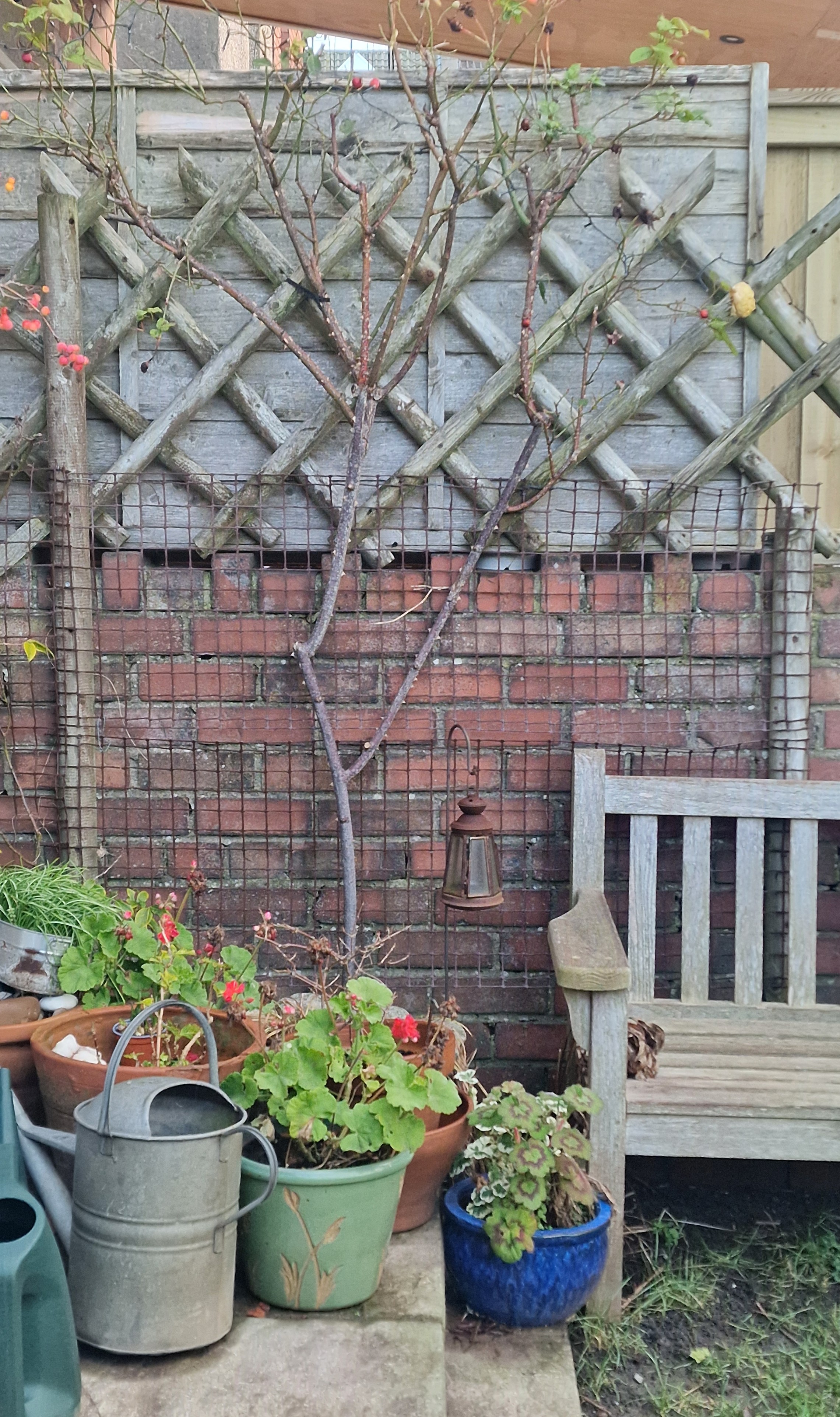
Thanks for your question about pruning your climbing rose. From what you're describing with only fresh growth at the top, you've got a classic case of a neglected climber that's crying out for renovation pruning. The good news is that roses are remarkably resilient, and with a bit of patience, you can transform this back into a floriferous beauty.
Where to make your cuts
Look closely at those old woody stems lower down where you want to prune. You'll see small bumps or ribs along the stem, these are dormant buds (also called nodes). They're the key to successful renovation pruning. You want to make your cuts just above these nodes, at a 45 degree angle slanting away from the bud. Even on very old, thick wood, these dormant buds are still viable and will break into fresh growth once the apical dominance from the top growth is removed. Run your fingers along the stem, and where you feel these little bulges, that's where you can confidently cut.
I'd cut it back to maybe 1-2 feet tall to regenerate it.
If you can find outward facing nodes, even better, as this will encourage growth away from the centre of the plant rather than creating congestion. Don't worry if the wood looks completely dead and brown, roses have an incredible ability to regenerate from what appears to be ancient timber.
This is a two year job
Here's the reality that many gardening guides gloss over: hard renovation pruning of old climbing roses isn't an instant fix. When you cut back to the old wood, those dormant buds need time to wake up and produce new vigorous shoots. In the first year after your hard prune, you'll likely see quite modest new growth emerging from where you've cut. These fresh shoots need the entire growing season to establish themselves and lignify (harden off).
The second year is where the magic happens. Those shoots you encouraged in year one will now produce their own lateral flowering stems, and you'll start to see the framework of a properly shaped climbing rose emerging. During this period, it's absolutely crucial to feed your rose well. Use liquid feed when it's in leaf, and give it a good autumn mulch of organic peat free compost to support all this new growth. Think of it as physiotherapy for your rose, it needs time and nourishment to recover its strength.
https://youtu.be/-Occ2WuIBnU
Training horizontally is essential
Once you've got that fresh new growth emerging from your hard prune, training it horizontally rather than vertically is absolutely critical for maximising flowers and preventing that leggy, bare bottomed look you're trying to fix. When rose canes grow vertically, they produce flower inhibiting hormones that concentrate blooms only at the tips. It's the plant's natural way of reducing competition for resources.
However, when you train canes horizontally (or even at a 45 degree angle), you disrupt this hormone distribution. The result is that lateral flowering shoots develop all along the length of the cane, rather than just at the top. Instead of one or two flower clusters at the end of a long vertical shoot, a horizontally trained cane can produce twenty or thirty clusters along its entire length. It's genuinely transformative.
As your new shoots develop, tie them in to your support structure using soft ties or Velcro garden tape (much better than wire, which can damage the bark). Fan them out horizontally, spacing them evenly across your wall or fence. This also improves air circulation and sunlight penetration, which helps prevent fungal diseases like rust and blackspot.
Relevant Garden Ninja guides
For detailed pruning techniques, have a look at:
Final thoughts
Don't be afraid to be brutal with your cuts. It will look shocking initially, but roses evolved to cope with being browsed by deer and other herbivores, so they're built to regenerate from hard pruning. Just make sure you support the rose afterwards with regular feeding and watering during dry spells.
Let us know how you get on, and don't hesitate to post progress photos. We'd love to see the transformation!
Happy pruning!
Lee Garden Ninja
Hi @gh123456
Thanks for your question about pruning your climbing rose. From what you're describing with only fresh growth at the top, you've got a classic case of a neglected climber that's crying out for renovation pruning. The good news is that roses are remarkably resilient, and with a bit of patience, you can transform this back into a floriferous beauty.
Where to make your cuts
Look closely at those old woody stems lower down where you want to prune. You'll see small bumps or ribs along the stem, these are dormant buds (also called nodes). They're the key to successful renovation pruning. You want to make your cuts just above these nodes, at a 45 degree angle slanting away from the bud. Even on very old, thick wood, these dormant buds are still viable and will break into fresh growth once the apical dominance from the top growth is removed. Run your fingers along the stem, and where you feel these little bulges, that's where you can confidently cut.
I'd cut it back to maybe 1-2 feet tall to regenerate it.
If you can find outward facing nodes, even better, as this will encourage growth away from the centre of the plant rather than creating congestion. Don't worry if the wood looks completely dead and brown, roses have an incredible ability to regenerate from what appears to be ancient timber.
This is a two year job
Here's the reality that many gardening guides gloss over: hard renovation pruning of old climbing roses isn't an instant fix. When you cut back to the old wood, those dormant buds need time to wake up and produce new vigorous shoots. In the first year after your hard prune, you'll likely see quite modest new growth emerging from where you've cut. These fresh shoots need the entire growing season to establish themselves and lignify (harden off).
The second year is where the magic happens. Those shoots you encouraged in year one will now produce their own lateral flowering stems, and you'll start to see the framework of a properly shaped climbing rose emerging. During this period, it's absolutely crucial to feed your rose well. Use liquid feed when it's in leaf, and give it a good autumn mulch of organic peat free compost to support all this new growth. Think of it as physiotherapy for your rose, it needs time and nourishment to recover its strength.
Training horizontally is essential
Once you've got that fresh new growth emerging from your hard prune, training it horizontally rather than vertically is absolutely critical for maximising flowers and preventing that leggy, bare bottomed look you're trying to fix. When rose canes grow vertically, they produce flower inhibiting hormones that concentrate blooms only at the tips. It's the plant's natural way of reducing competition for resources.
However, when you train canes horizontally (or even at a 45 degree angle), you disrupt this hormone distribution. The result is that lateral flowering shoots develop all along the length of the cane, rather than just at the top. Instead of one or two flower clusters at the end of a long vertical shoot, a horizontally trained cane can produce twenty or thirty clusters along its entire length. It's genuinely transformative.
As your new shoots develop, tie them in to your support structure using soft ties or Velcro garden tape (much better than wire, which can damage the bark). Fan them out horizontally, spacing them evenly across your wall or fence. This also improves air circulation and sunlight penetration, which helps prevent fungal diseases like rust and blackspot.
Relevant Garden Ninja guides
For detailed pruning techniques, have a look at:
Final thoughts
Don't be afraid to be brutal with your cuts. It will look shocking initially, but roses evolved to cope with being browsed by deer and other herbivores, so they're built to regenerate from hard pruning. Just make sure you support the rose afterwards with regular feeding and watering during dry spells.
Let us know how you get on, and don't hesitate to post progress photos. We'd love to see the transformation!
Happy pruning!
Lee Garden Ninja

 Lee Burkhill: Award Winning Designer & BBC 1's Garden Rescue Presenters Official Blog