Hello @skybuds and welcome to the Garden Ninja community!
You’ve unfortunately stumbled into one of the more frustrating issues with modern new build developments, and I completely understand your concern about the plastic mesh.
This is something I’ve encountered numerous times across Manchester, Cheshire and beyond, and it’s frankly an environmental nightmare that the horticultural industry needs to address properly.
The mesh you’re dealing with is typically a lightweight plastic netting that turf growers use to stabilise the root system during the growing process and to make handling easier when harvesting and laying. It allows them to grow turf faster and transport it without it falling apart, which makes commercial sense but creates significant problems for homeowners and the environment.
The turf roots grow through this mesh, which means it becomes completely integrated into the grass root system within weeks of being laid.
The Environmental Catch 22
Here’s where we hit the real problem, and I’m going to be completely honest with you because this isn’t straightforward.
Whilst I absolutely understand your concern about microplastics and degradation over time, the harsh reality is that attempting to remove established turf with plastic mesh will likely release far more plastic fragments into your soil than leaving it in place.
Every time you lift a section, cut through roots, or try to separate the mesh from the turf, you’re breaking down that plastic into smaller pieces that then get worked into your topsoil where they’ll remain indefinitely.
If the turf is already established and the mesh is well integrated with the root system, my personal advice would actually be to leave it in situ. Yes, it will eventually degrade, but this process takes many years, and during that time the plastic remains in larger pieces held together by the turf roots rather than being actively broken down and distributed through your soil by removal attempts.
It’s not a perfect solution by any means, but sometimes the least worst option is the one we have to accept.
If You’re Committed to Removal
However, if you’ve already started the process or you’re absolutely determined to get it out, then you need to understand that this is going to be labour intensive and you definitely cannot use a turf cutter.
Those machines will snag on the mesh immediately, potentially damaging the equipment and creating an absolute mess of tangled plastic and torn turf. You’ve been given good advice there.
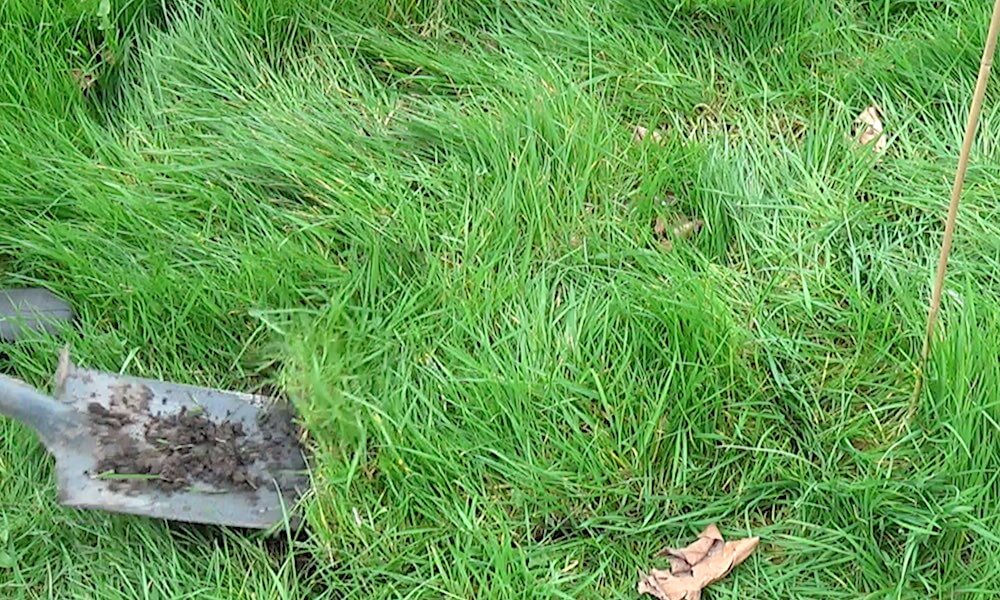
Your best approach is manual removal using a sharp spade, working in small sections and being prepared for this to take considerably longer than normal turf removal.
Cut the turf into manageable strips of around 30cm wide, then use the spade to slice underneath at root depth. You’ll need to work slowly and accept that you’re going to be pulling up mesh along with the turf.
Your idea of leaving the sods to rot down so you can extract the mesh separately is sound in theory, but be aware that the mesh is so integrated that you’ll still end up with fragments.
Stack the turves grass side down in an out of the way spot and give them at least six months to break down before attempting to separate the mesh.
The Bigger Picture
The frustrating truth is that this practice of using plastic mesh for turf growing is widespread across the industry, and new build developers rarely specify mesh free turf because it’s cheaper and easier to source.
As someone who’s passionate about sustainable, plastic free gardening methods, this drives me absolutely mad. When I’m specifying turf for client gardens, I always insist on mesh free varieties, but I’m aware that many homeowners don’t get that choice with new builds.
Whatever you decide, don’t beat yourself up about this situation. You’ve inherited a problem that wasn’t of your making, and there’s no perfect solution here.
If you do proceed with removal, work carefully, accept it’s going to be slow going, and consider what you’re planning to replace the lawn with. If you’re moving towards planted borders, paths or hardscaping, then removal makes more sense despite the plastic issue.
If you’re planning to re-turf or seed a new lawn, you might want to seriously reconsider whether the removal is worth the environmental cost of all those plastic fragments.
Additional Reading
For more information about lawn care, removal and alternatives, these articles from the Garden Ninja site might be helpful:
Lawn care and alternatives
Good luck with whatever you decide, and feel free to post updates or further questions. There are plenty of experienced gardeners here who can offer support!
Lee
Hello @skybuds and welcome to the Garden Ninja community!
You’ve unfortunately stumbled into one of the more frustrating issues with modern new build developments, and I completely understand your concern about the plastic mesh.
This is something I’ve encountered numerous times across Manchester, Cheshire and beyond, and it’s frankly an environmental nightmare that the horticultural industry needs to address properly.
The mesh you’re dealing with is typically a lightweight plastic netting that turf growers use to stabilise the root system during the growing process and to make handling easier when harvesting and laying. It allows them to grow turf faster and transport it without it falling apart, which makes commercial sense but creates significant problems for homeowners and the environment.
The turf roots grow through this mesh, which means it becomes completely integrated into the grass root system within weeks of being laid.
The Environmental Catch 22
Here’s where we hit the real problem, and I’m going to be completely honest with you because this isn’t straightforward.
Whilst I absolutely understand your concern about microplastics and degradation over time, the harsh reality is that attempting to remove established turf with plastic mesh will likely release far more plastic fragments into your soil than leaving it in place.
Every time you lift a section, cut through roots, or try to separate the mesh from the turf, you’re breaking down that plastic into smaller pieces that then get worked into your topsoil where they’ll remain indefinitely.
If the turf is already established and the mesh is well integrated with the root system, my personal advice would actually be to leave it in situ. Yes, it will eventually degrade, but this process takes many years, and during that time the plastic remains in larger pieces held together by the turf roots rather than being actively broken down and distributed through your soil by removal attempts.
It’s not a perfect solution by any means, but sometimes the least worst option is the one we have to accept.
If You’re Committed to Removal
However, if you’ve already started the process or you’re absolutely determined to get it out, then you need to understand that this is going to be labour intensive and you definitely cannot use a turf cutter.
Those machines will snag on the mesh immediately, potentially damaging the equipment and creating an absolute mess of tangled plastic and torn turf. You’ve been given good advice there.
Your best approach is manual removal using a sharp spade, working in small sections and being prepared for this to take considerably longer than normal turf removal.
Cut the turf into manageable strips of around 30cm wide, then use the spade to slice underneath at root depth. You’ll need to work slowly and accept that you’re going to be pulling up mesh along with the turf.
Your idea of leaving the sods to rot down so you can extract the mesh separately is sound in theory, but be aware that the mesh is so integrated that you’ll still end up with fragments.
Stack the turves grass side down in an out of the way spot and give them at least six months to break down before attempting to separate the mesh.
The Bigger Picture
The frustrating truth is that this practice of using plastic mesh for turf growing is widespread across the industry, and new build developers rarely specify mesh free turf because it’s cheaper and easier to source.
As someone who’s passionate about sustainable, plastic free gardening methods, this drives me absolutely mad. When I’m specifying turf for client gardens, I always insist on mesh free varieties, but I’m aware that many homeowners don’t get that choice with new builds.
Whatever you decide, don’t beat yourself up about this situation. You’ve inherited a problem that wasn’t of your making, and there’s no perfect solution here.
If you do proceed with removal, work carefully, accept it’s going to be slow going, and consider what you’re planning to replace the lawn with. If you’re moving towards planted borders, paths or hardscaping, then removal makes more sense despite the plastic issue.
If you’re planning to re-turf or seed a new lawn, you might want to seriously reconsider whether the removal is worth the environmental cost of all those plastic fragments.
Additional Reading
For more information about lawn care, removal and alternatives, these articles from the Garden Ninja site might be helpful:
Lawn care and alternatives
Good luck with whatever you decide, and feel free to post updates or further questions. There are plenty of experienced gardeners here who can offer support!
Lee
 Lee Burkhill: Award Winning Designer & BBC 1's Garden Rescue Presenters Official Blog