How to Design a Long Thin Garden: Transform Your Corridor into a Stunning Journey
Lee Burkhill: Award Winning Designer & BBC 1's Garden Rescue Presenters Official Blog
Beginner level
Long thin gardens are one of Britain's most common awkward shapes, creating frustrating corridor effects that most homeowners struggle to solve. This comprehensive guide reveals professional design strategies to transform narrow plots into stunning outdoor spaces using strategic zoning, diagonal pathways, and clever planting that emphasises width over length for genuinely captivating results!
Staring down that narrow strip of garden stretching away from your house, you might be feeling like you’ve drawn the short straw in the garden lottery. Long thin gardens are probably the most common awkward shape in British suburbia, particularly in Victorian terraces, post-war developments, and those estate properties where developers sliced up former agricultural land into the maximum number of saleable plots.
What you’re left with is essentially a green corridor, often barely wide enough to swing a cat, running away into the distance like some botanical bowling alley.
The temptation with long, thin gardens is either to give up entirely and chuck down some turf with borders along each side. Or attempting to hide the shape through whatever shrubs you’ve just randomly picked from the garden centre until it’s so overgrown you can barely get down there.
Neither approach works. The first creates that depressing tunnel effect where your eye shoots straight to the back fence and you’re left underwhelmed, whilst the second turns your garden into an impenetrable jungle that’s more hassle than it’s worth.
I’ve been designing gardens professionally for over 15 years, presented 56 episodes of BBC Garden Rescue, and transformed countless long, thin plots from disappointing corridors into genuinely captivating outdoor spaces that people actually want to spend time in.
Long, thin gardens aren’t design disasters waiting to happen; they’re opportunities to create a journey and discovery in ways that more compact plots cannot achieve. That very length which feels like a limitation is actually your greatest asset once you understand how to work with it properly.
This comprehensive guide will walk you through exactly how to transform your long, thin garden using the same design principles I teach in my Garden Design for Beginners course and apply on Garden Rescue. Whether your garden runs for ten metres or forty metres, you’ll discover practical solutions that work in real British gardens with real budgets and real maintenance constraints.
Why Long Thin Gardens Feel So Awkward
Before jumping into solutions, let’s properly understand why long, thin gardens feel so awkward in their natural state. Getting your head around the problem is essential to solving it effectively rather than just applying cosmetic fixes that don’t address the fundamental issues.
The primary problem with long, thin gardens is the tunnel effect.
When you can see straight from your back door to the far boundary in one uninterrupted sight line, your brain processes the space as a corridor rather than a garden.
There’s no mystery, no reason to actually venture down there, and the narrowness feels even more pronounced because you’re constantly aware of those parallel boundaries converging into the distance. The typical layout compounds this tunnel effect that most people default to, which is a lawn down the middle with borders along each fence. This arrangement doesn’t disguise the shape; it emphasises it.
The second major challenge is proportion. In most long, thin gardens, the width-to-length ratio is entirely out of balance. You might have thirty metres of length but only four or five metres of width, which creates genuinely complex design challenges around creating spaces that feel comfortable rather than cramped. As I discuss in my guide to starting with garden design, getting proportions right is crucial, and long, thin plots make this considerably harder than more balanced shapes.
The third issue is that long, thin gardens often suffer from variable conditions down their length. The area near the house might be sunny and sheltered, whilst the far end is shaded by neighbouring trees and exposed to wind. Your soil drainage might be entirely different at each end.
This variation means you can’t just repeat the same planting scheme throughout; you need to respond to changing conditions whilst maintaining overall cohesion. That’s genuinely challenging even for experienced designers.
The Golden Rules for Long Thin Garden Design
After designing dozens of long, thin plots across different scales, budgets, and client requirements, I’ve distilled the approach into four fundamental principles that apply whether you’re working with a skinny urban plot or a longer suburban garden.
Rule One: Break the Tunnel Immediately
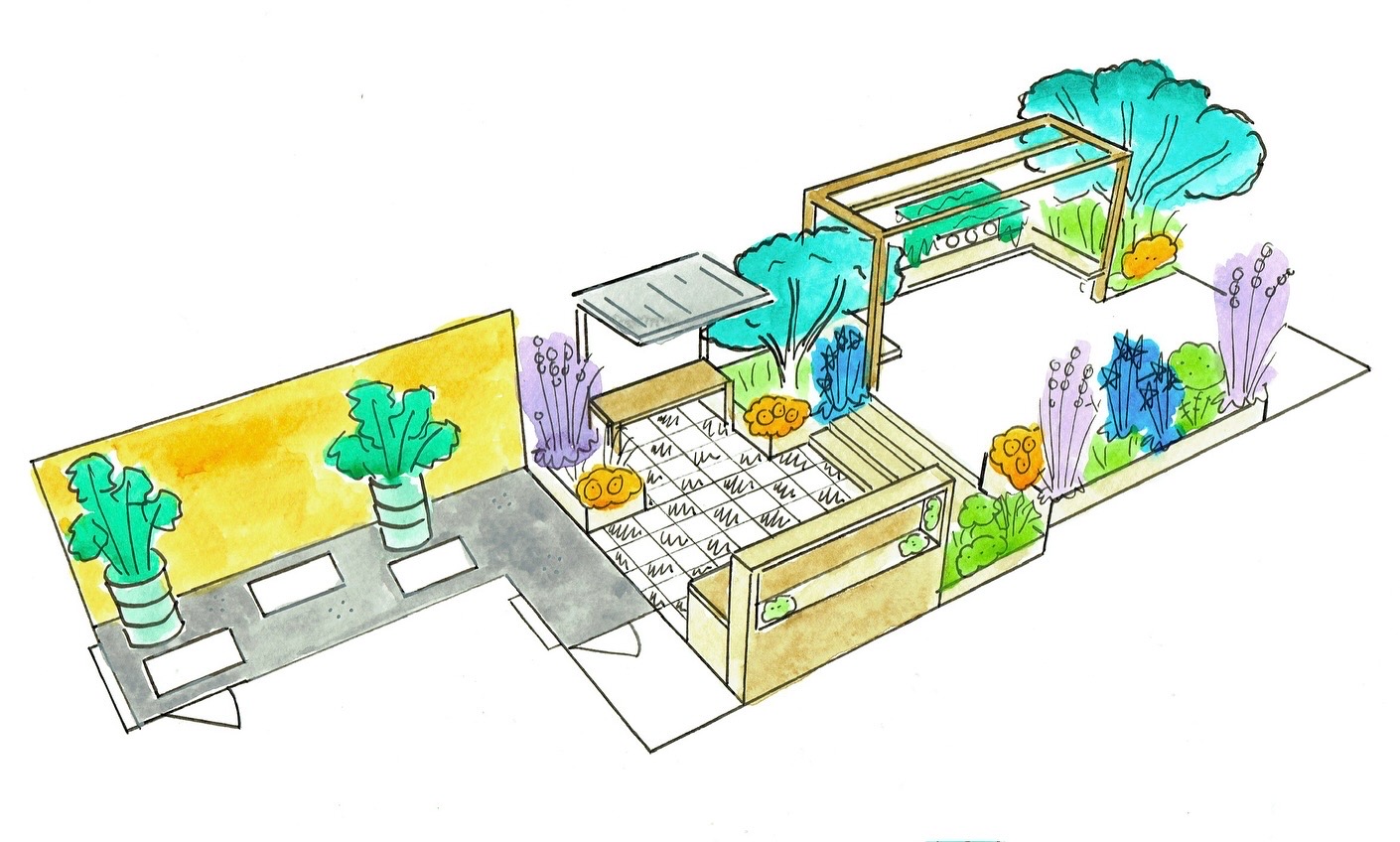
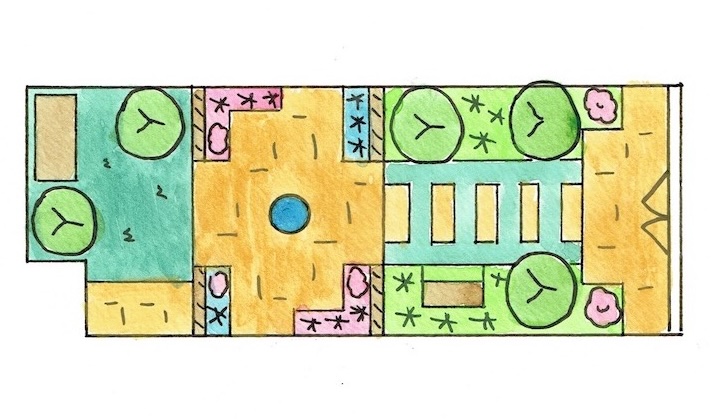
The absolute cardinal sin of long, thin garden design is allowing an uninterrupted view from the house to the back boundary. This creates the corridor effect, making the narrowness utterly overwhelming. Instead, you must break up that sight line immediately by using strategic screening, level changes, or bold architectural features that prevent you from seeing the whole garden at once.
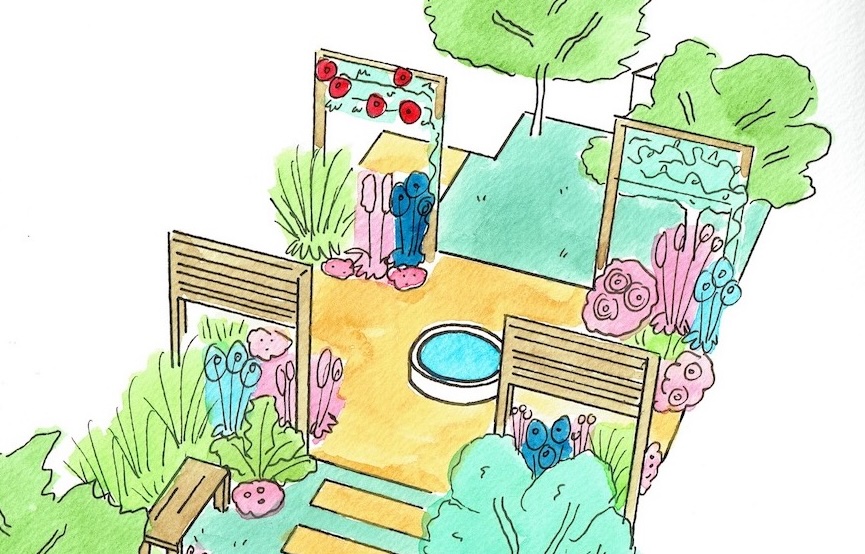
The most effective method I’ve used is creating distinct garden rooms or zones that partially obscure what lies beyond. These divisions don’t need to be solid barriers; in fact, they work better when they’re not. Effective screening options include:
A pergola with climbers creating partial overhead coverage
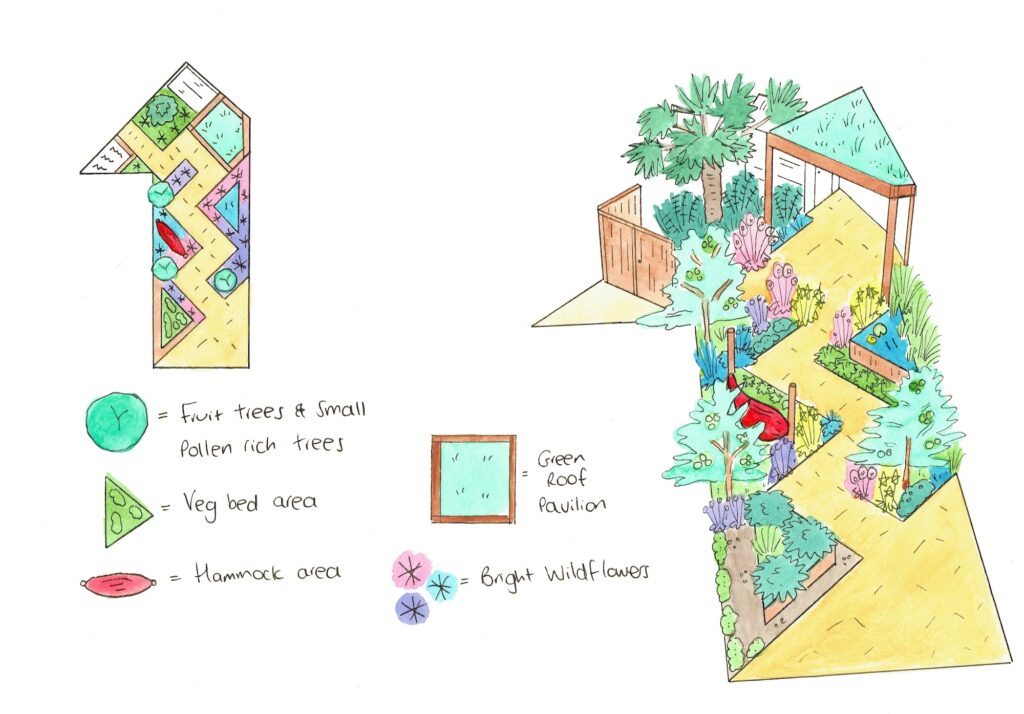
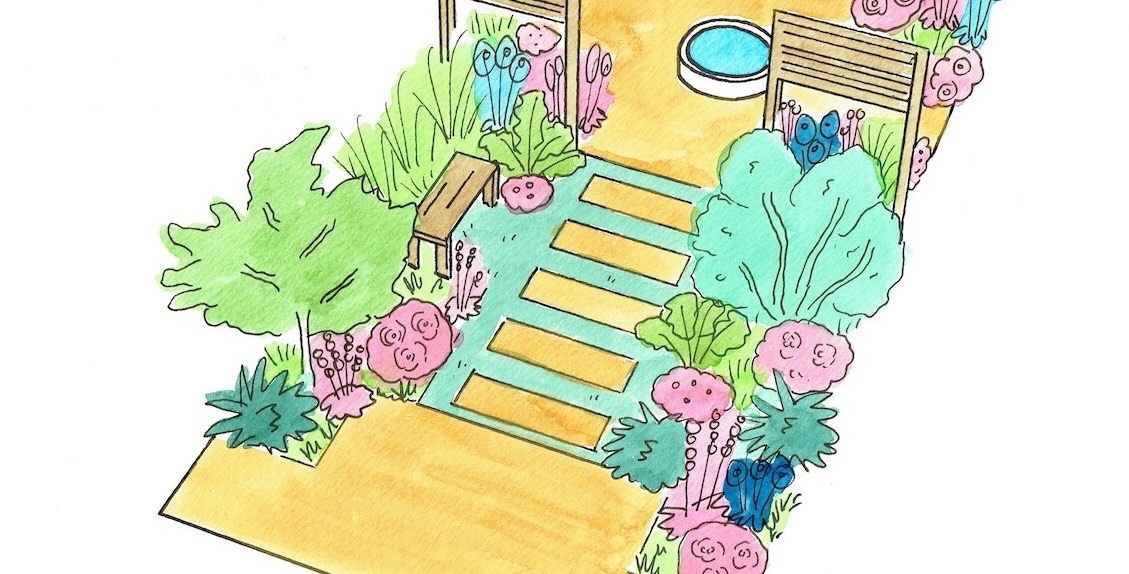
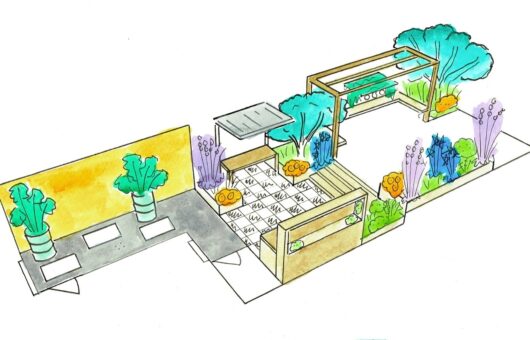
Using the 45-degree angle as seen above for paths
A subtle change in level using steps or raised beds
Strategically placed large shrubs or small trees that interrupt sight lines
Trellis panels or posts with climbers that you can see through but not past
The key is making sure you can glimpse what’s beyond without seeing everything, creating intrigue that draws you into the garden. This is the same principle I use in my family friendly garden designs where zones create both function and discovery.
Rule Two: Design Horizontally, Not Vertically
This sounds counterintuitive, but the key to successful long thin gardens is emphasising width rather than length. Everything in your design should work to trick the eye into perceiving the space as wider than it actually is. This means avoiding straight paths or lawn strips running the full length, using 45-degree diagonals to move across the width rather than down the length, and creating horizontal features that draw attention sideways.
45-degree pathways that meander from side to side rather than shooting straight back are crucial here. Each angle forces you to look left and right, experiencing the width rather than being funnelled relentlessly towards the back. Horizontal planting drifts that sweep across the garden width achieve similar effects. Even your paving patterns can help, with materials laid across the width rather than running lengthways, creating subtle visual cues that emphasise breadth over length.
Rule Three: Create Destination Points
In my small garden design guide, I emphasise the importance of giving people reasons to use different areas. This matters even more in long, thin gardens where the far end often becomes neglected because there’s simply no reason to go down there. You need to create destinations that pull people through the space.
These destinations might be practical, such as a tucked-away seating area perfect for morning coffee away from the house, a vegetable-growing zone, or a storage shed.
They might be aesthetic, such as a water feature, sculpture, or specimen tree, positioned as a focal point. Whatever you choose, it needs sufficient interest to justify the journey down the garden. Without destination points, long, thin gardens become dead spaces where you occasionally venture to retrieve a football but otherwise ignore completely.
Rule Four: Use Repetition for Cohesion
Long, thin gardens can easily feel disjointed, like a series of separate spaces with no connection between them. To prevent this, you need strong repeated elements that run through the entire design, creating unity despite the zoning.
This might be:
A consistent paving material is used in each zone
Repeated plant palettes repeating down the length
Consistent colours in your paving and hard landscaping choices
Use similar evergreen shrubs in each section to connect the areas
The same mulch or gravel type is used throughout
The repetition creates rhythm and ensures the garden reads as a cohesive whole rather than random sections stuck together. In my modern garden design makeovers, I always use repetition in materials and planting to tie disparate zones together, and this technique works brilliantly in long, thin spaces where it’s easy to lose that sense of connection.
Practical Design Solutions for Different Long Thin Scales
Not all long, thin gardens are created equal. The specific design approach you’ll need depends largely on both the overall length and the width you’re working with.
Narrow and Long (Under 4 Metres Wide)
If your garden is genuinely narrow at less than four metres wide, you’re working with seriously constrained space where every design decision has enormous impact. These skinny corridors are common in Victorian terraces and older urban properties, where plots were often carved up with minimal consideration for generous outdoor space.
For very narrow gardens, forget about having pathways and borders running parallel down both sides. This arrangement makes the space feel even narrower by emphasising those boundary lines. Instead, run your main path down one side, leaving the opposite side open for deeper planting, ideally 1.2-1.5m ifg possible, that can actually make an impact.
A path needs minimum 80cm width to feel comfortable, which in a narrow garden is a significant chunk of your total width. By committing it to one side, you free up the remaining space for generous planting rather than apologetic strips on both sides.
Consider vertical solutions aggressively in narrow plots. Climbers on every available wall and fence surface add greenery without consuming precious ground space. Wall-mounted planters, hanging baskets, and even living wall panels can create lush planting that doesn’t reduce your already limited width. The eye needs to be drawn upwards in narrow spaces to avoid that oppressive corridor feeling, and vertical planting achieves exactly that.
For truly skinny gardens under three metres wide, you might need to accept that a traditional lawn is more hassle than it’s worth. A strip of grass that is narrow becomes a faff to maintain and doesn’t provide meaningful function. Consider alternatives like gravel, bark mulch, or low-growing ground cover plants that create green coverage without demanding weekly mowing in an awkwardly shaped space.
Medium Width (4 to 6 Metres Wide)
Gardens in this width bracket offer considerably more design flexibility whilst still presenting challenges around that elongated proportion. These are probably the most common long, thin garden dimensions in British suburbs, giving you just enough width to create proper zones without feeling utterly cramped.
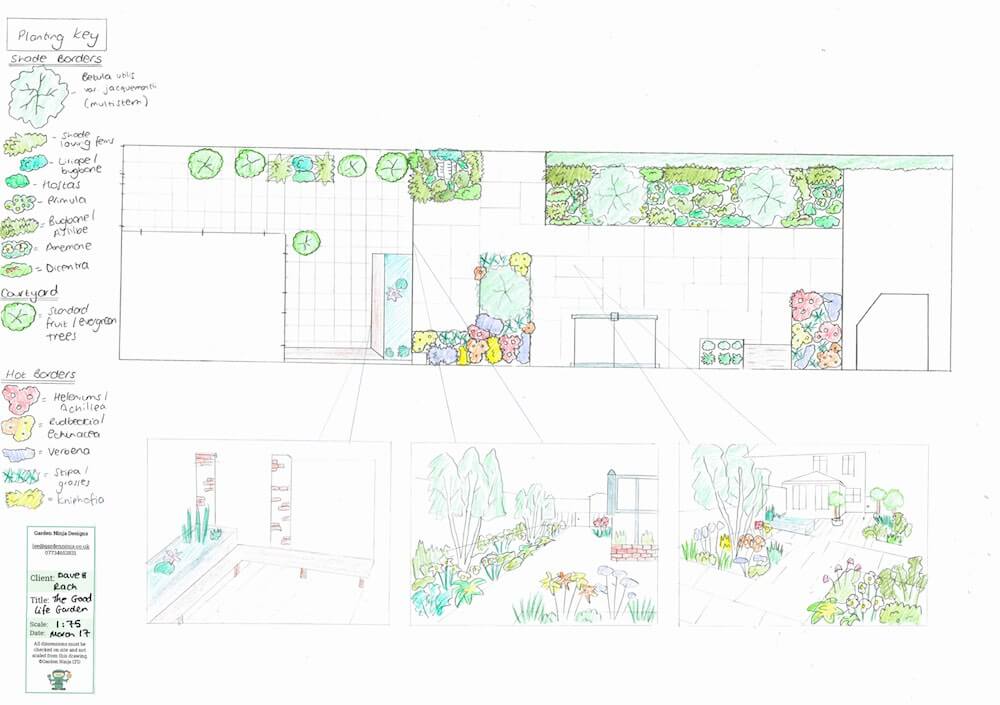
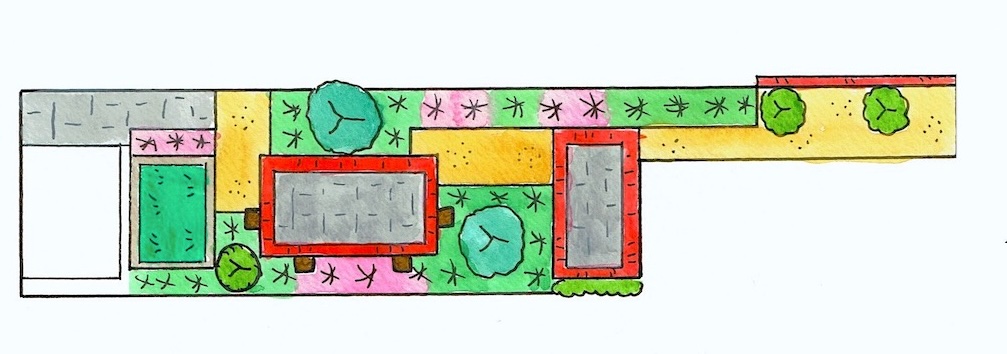
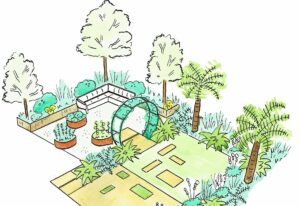
For medium-width long gardens, breaking up the zones with structures like arches or screens works brilliantly. This helps section off the garden into different areas, slowing down your gaze and making the garden feel more immersive. Below I’ve used two patios, edged in reclaimed bricks and then some suitable small garden trees to break up the eye line as you travel down the garden.
This is where garden rooms really come into their own. You can realistically divide a medium-width, long garden into three or four distinct zones, each with its own character and purpose. Perhaps:
A paved entertaining area near the house for dining and relaxation
A lawn section for children’s play or simply visual relief
A tucked-away seating area or utility space at the far end
Each zone transition is marked by a change in materials, level, or screening that prevents you from taking in the whole space at once.
Wider Long Gardens (Over 6 Metres Wide)
If you’ve got a width exceeding six metres whilst still having significant length, you’re working with a garden that’s long but not especially thin. These proportions offer a genuine opportunity to create multiple parallel zones or more ambitious features that would overwhelm narrower plots.
Wider long gardens can accommodate side-by-side zoning rather than just sequential rooms down the length. Imagine having a main pathway down one side connecting various destinations, whilst the opposite side features continuous deep planting or even a lawn area. This breaks up the linearity because you’re using width creatively rather than just length.
These wider spaces can also accommodate architectural features that need proper breathing room. Pergolas, arches, substantial water features, or even small outbuildings positioned off centre become viable options. The key is to ensure that these features work to divide and articulate the space, rather than being randomly placed. Every element should contribute to breaking that tunnel effect and creating journey through the garden.
Zoning Strategies That Actually Work
Getting your zoning right in long, thin gardens is absolutely crucial. Done well, it transforms the space from a corridor to a series of experiences. Poorly done, it creates disjointed chaos with no flow or connection between areas.
Zone One: The Immediate Entertaining Space
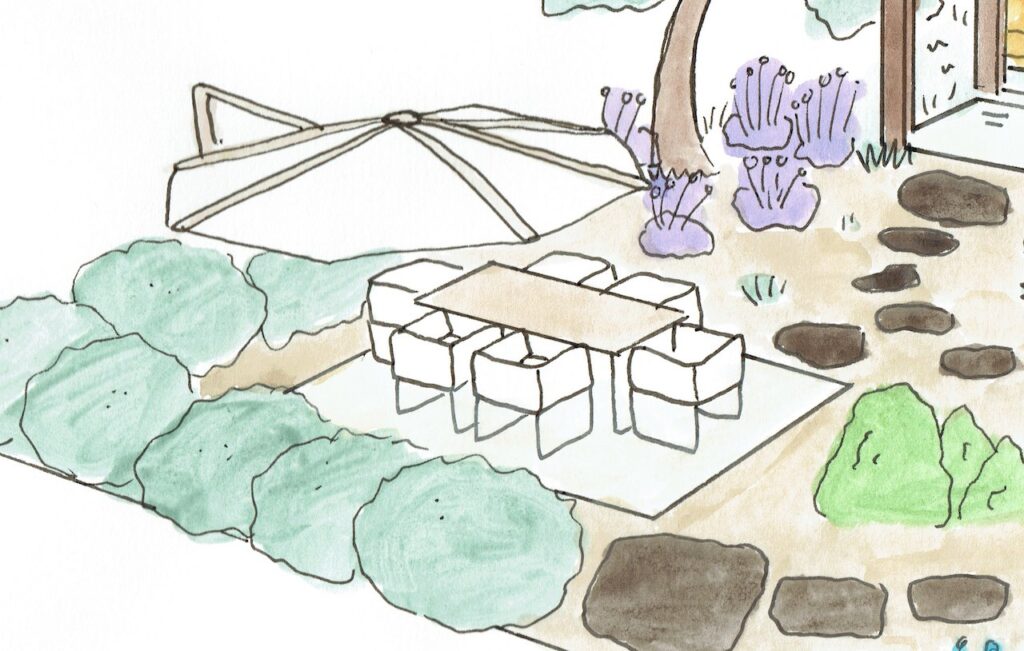
The area directly adjacent to your house is almost always your primary entertaining zone. This wants to feel like an extension of your home, providing comfortable space for dining, lounging, or simply sitting with a brew.
In long, thin gardens, resist the temptation to make this zone too shallow just because you’re anxious about using up your limited length. A patio that’s only two metres deep is pointless because you can’t fit proper furniture on it comfortably.
Instead, commit to creating a properly sized entertaining space of at least three metres depth, preferably more. This might consume what feels like a large proportion of your total length, but it’s absolutely necessary for the space to function properly. Better to have one usable zone than three inadequate ones. The width of this area naturally extends across most or all of your garden width, creating that generous feeling right where you spend the most time.
Zone Two: The Transition or Multi-Purpose Space
Moving away from the house, you need a transition zone that provides a visual and physical journey towards whatever lies beyond. This middle section is ideal for a lawn if you prefer grass, or for generous borders if you’re more plant-focused. The key is ensuring this zone doesn’t just feel like leftover space between the entertaining area and whatever’s at the far end.
Consider using curves in this middle section to create interest and a wider perception. A curved lawn edge that swells out on one side before curving back creates visual movement. Just make sure the curves are big enough and not just a wiggly worm style curve which never works.
Borders that bulge and recede rather than running parallel create rhythm. In my child friendly garden designs, I often use this middle zone for play areas or growing spaces, tucked away from the house but still accessible and visible.
Zone Three: The Destination or Utility Space
The far end of your long, thin garden needs a clear purpose. This might be practical utility storage, a shed, or compost bins hidden behind attractive screening. Or it might be a peaceful seating area tucked away at the furthest point from the house, where morning sun hits beautifully. Perhaps it’s your productive vegetable-growing zone, where you can create proper raised beds without them dominating the view from the house.
Whatever you choose, this end zone needs sufficient interest and function to justify the journey down the garden. An empty, bare patch at the back, with no features and no reason to visit, becomes neglected, dead space. Even if it’s primarily utility-focused, frame it attractively with screening plants and ensure the access route makes getting there straightforward rather than an obstacle course through overgrown borders.
Pathways That Create Journey Not Corridors
Getting your pathway strategy right in long, thin gardens is absolutely fundamental to success. The path defines how you experience the space, and a straight path running the full length is design suicide that emphasises every limitation of the shape.
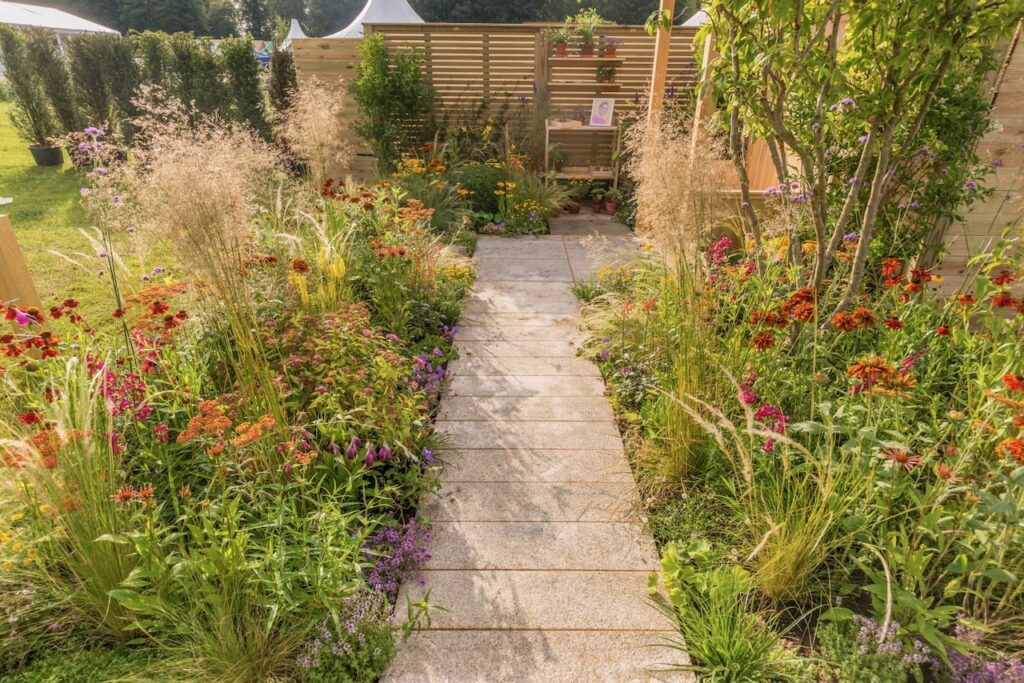
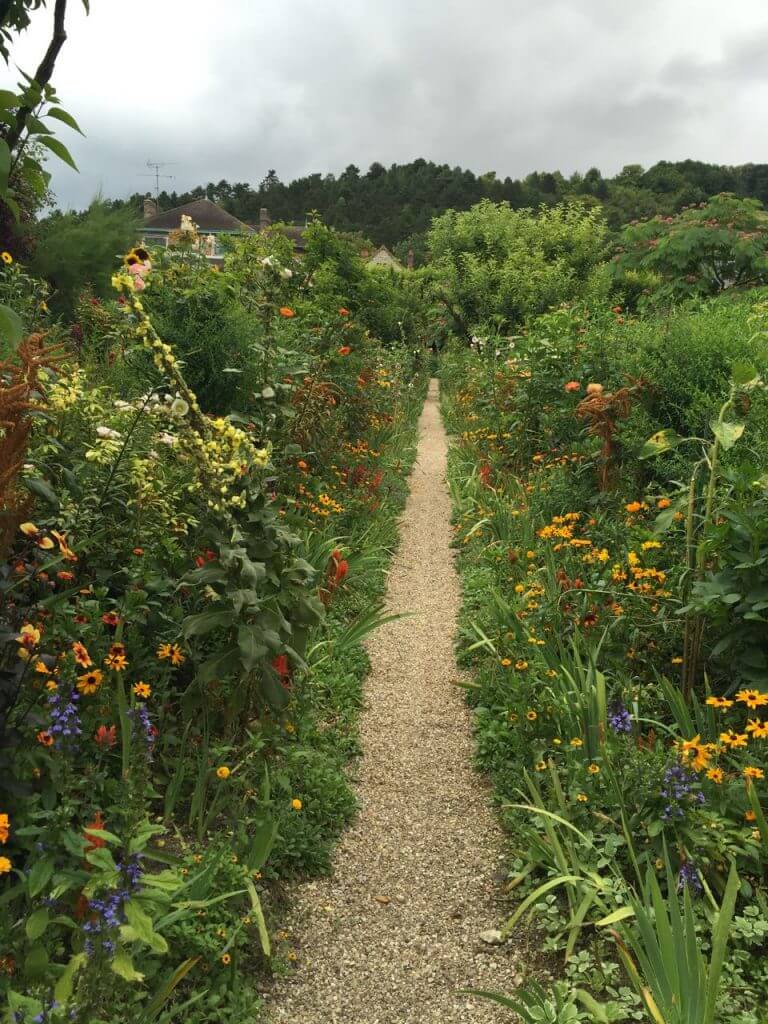
Instead, create pathways that move diagonally or in gentle curves across the width of the garden. These don’t need to be elaborat,e serpentine wiggles that feel forced. Even subtle curves that shift the path from one side to the other create an enormous difference in how the space feels. Each curve provides a slightly different viewpoint, encouraging you to look sideways rather than just straight ahead, and breaks up that relentless perspective along its length.
For very long gardens, consider creating multiple pathway routes rather than one main spine. Perhaps stepping stones through a lawn area offering one route, with a more substantial paved path along one side providing weatherproof access to a shed or growing zone. This variety creates choice and interest, turning the necessity of getting from A to B into an experience rather than just functional access.
The materials and width of your paths matter enormously in long, thin spaces. In narrow gardens, commit your path to one side and make it a proper width of 80 to 120cm to make it purposeful.
In wider gardens, you can afford to reduce the path width to 60 to 80cm if the path meanders through planted areas, but avoid narrowing it further, as it can feel restrictive and uncomfortable to use. For materials, consider using different surfaces for different zones to reinforce the room concept. Perhaps porcelain paving near the house, transitioning to gravel in the middle section, then bark or stepping stones at the far end.
Planting Strategies for Long Thin Gardens
Getting the planting right in long, thin gardens requires balancing several competing demands. You need depth and impact in your planting to break up the narrowness, but you can’t overwhelm the limited width. You need variety to prevent monotony down the length, but sufficient repetition to create cohesion rather than chaos.
Start with structural evergreens positioned strategically to break sight lines without creating solid barriers. These might be specimen shrubs like Viburnum tinus or Pittosporum positioned at key points where zones transition. Or perhaps small trees like multi-stem birch or amelanchier that provide vertical interest and partial screening. The positioning matters more than the species; you’re creating visual punctuation marks that interrupt that straight view down the garden.
For border planting, work in drifts and layers rather than the tired graduated approach of tall at back, short at front. Allow taller perennials to come forward in places, creating undulation and movement in your borders. Use generous groups of the same species repeated at intervals down the length rather than a chaotic jumble of singles. In long gardens, this repetition becomes your unifying thread whilst still allowing for variety, responding to changing conditions.
Pay particular attention to planting that softens and disguises your boundaries. Key boundary treatments include:
Climbers on every available vertical surface for greenery without ground space
Informal mixed planting that varies in height down the length
Avoiding uniform hedge lines that emphasise parallel sides
For colour strategy in long thin gardens, consider using warmer colours like reds, oranges, and yellows towards the far end, with cooler blues, purples, and whites near the house. This creates a perspective illusion, making the far end feel closer and the garden more balanced. It’s a subtle yet genuinely effective trick when executed properly.
Common Long Thin Garden Mistakes to Avoid
I’ve seen the same errors crop up repeatedly in long, thin gardens, and learning from these mistakes is cheaper than making them yourself.
Mistake One: The Straight Lawn Strip
A rectangular strip of lawn running the full length of your garden with narrow borders on each side is peak design laziness. It creates exactly the corridor effect you’re trying to avoid, provides no interest or variety, and makes maintenance awkward because you’re constantly mowing a long, narrow strip. If you want a lawn, consider offsetting it rather than centralising it, position it in one section rather than running the full length, or break it up with planted areas that create variety.
Mistake Two: Trying to Fit Too Many Zones
I see this constantly, especially in very long gardens where people try cramming in five or six different areas because they’re excited about all the possibilities. The result is a disjointed mess where nothing feels properly considered and the transitions between zones feel arbitrary. Three or four well-conceived zones almost always work better than six rushed ones. Quality over quantity applies absolutely to garden zoning.
Mistake Three: Ignoring the Far End
Spending all your design energy and budget on the area near the house, whilst treating the far end as an afterthought, creates an obvious imbalance. Yes, you’ll spend more time near the house, but that distant area needs consideration too, otherwise it becomes neglected wasteland. Even if it’s primarily functional utility space, frame it attractively and ensure it feels like a deliberate part of the overall design.
Mistake Four: Weak Boundaries
In long, thin gardens, your boundary fences or walls are unavoidably prominent. Leaving them as bare panels or brick creates harsh lines that emphasise the narrowness. Instead, absolutely commit to covering boundaries with climbers, wall shrubs, or layered planting. This softens the space dramatically and makes those parallel sides feel less oppressive. In my new build garden guide, I discuss how crucial boundary treatment is for creating atmosphere rather than just enclosure.
Quick Reference Design Guide
Design Element
Best Practice for Long Thin Gardens
What to Avoid
Main pathway
Destination at the far end plus intermediate features
Straight path running full length
Lawn position
Curved shape in one section
Rectangular strip running full length
Border depth
Generous on alternating sides
Narrow strips on both sides
Screening
Partial barriers between zones
Complete openness or solid walls
Focal points
Repeated species at intervals down the length
Single focal point at back only
Planting rhythm
Single focal point at the back only
Complete variety with no repetition
Making Your Long Thin Garden Work for Your Budget
Long, thin gardens shouldn’t require unlimited budgets to succeed. Some of the most effective transformations I’ve achieved have been through phased implementation and strategic investment rather than attempting everything simultaneously.
Start by arranging your main entertaining zone near the house properly with high-quality hard landscaping. This is where you’ll spend most time, so investing in decent paving or decking that’s correctly installed makes sense. You can then phase the rest of the garden over subsequent seasons, perhaps installing temporary gravel or bark paths initially that can be upgraded to more permanent solutions when the budget allows.
For zoning and screening, plants offer brilliant value compared to built structures. A few strategically positioned shrubs or small trees costing £30 to £50 each can create effective division and screening that would cost hundreds or thousands in built structures.
These plants will grow and improve with time, whereas built features are static. Climbers are absolute bargains for covering boundaries, with fast-growing species like clematis, honeysuckle, or even annual sweet peas providing rapid coverage for minimal investment.
My Garden Design for Beginners course, priced at £199, provides comprehensive training on design principles, zoning strategies, and planting plans tailored explicitly for awkward shapes, including long, thin gardens.
You’ll learn the professional approaches I use on Garden Rescue, adapted for self-builders working within realistic budgets. The 30 Garden Design Templates courseat just £29 includes several long, thin garden solutions with complete planting plans and explanations of the design logic, taking the guesswork out of creating professional results.
29
Garden Design Examples for Small Gardens: 30 Design Templates & Planting Plans
Garden Design Examples for Small Gardens: 30 Design Templates & Planting Plans: In this online gardening course, I’ll walk you through 30 fantastic garden designs, explaining the logic behind the layout, the plant choices, and take-home tips for applying them in your own garden.
Weekend Garden Makeover: A Crash Course in Design for Beginners
Learn how to transform and design your own garden with Lee Burkhills crash course in garden design. Over 5 hours Lee will teach you how to design your own dream garden. Featuring practical design examples, planting ideas and video guides. Learn how to design your garden in one weekend!
Garden Design for Beginners: Create Your Dream Garden in Just 4 Weeks
Garden Design for Beginners Online Course: If you want to make the career jump to becoming a garden designer or to learn how to design your own garden, this is the beginner course for you. Join me, Lee Burkhill, an award-winning garden designer, as I train you in the art of beautiful garden design.
For those preferring personalised guidance, my online garden design consultations starting at £250 provide expert advice on layout, zoning, and plant selection specifically for your long, thin plot. Sometimes, an hour with an experienced designer at the planning stage can save thousands in expensive mistakes during implementation.
Transform Your Long Thin Garden with Confidence
Long, thin gardens are genuinely challenging, but they’re far from impossible. Every awkward dimension represents an opportunity for creative problem-solving.
The key to success lies in understanding fundamental principles rather than just copying generic layouts from magazines or Pinterest. Strategic zoning, curved or diagonal pathways that emphasise width, partial screening that creates mystery without isolation, and repetition providing cohesion despite variety. These aren’t complex concepts, but they require understanding proper design principles rather than just guessing and hoping.
Your long, thin garden is waiting to become the journey you didn’t know you needed. Let’s make it happen!
Lee Burkhill, known as the Garden Ninja, is an award-winning garden designer and horticulturist with over 30 years of gardening experience and 15 years as a professional garden designer. A qualified RHS (Royal Horticultural Society) professional, Lee specialises in sustainable garden design and practical horticultural advice. He designs and presents on BBC1’s Garden Rescue and in leading gardening publications. Lee combines three decades of hands-on gardening knowledge with professional design qualifications to help gardeners create beautiful, functional outdoor spaces.