Chinese Garden Design Guide: Principles and Plants for UK Gardens
Lee Burkhill: Award Winning Designer & BBC 1's Garden Rescue Presenters Official Blog
Expert level
Traditional Chinese gardens showcase some of the most considered garden design techniques. Whether it be the scale of a neatly pruned pine tree or the positioning of a symbolic rock, Chinese garden design is not just sticking some temple statues and the odd bamboo into a pot. It's so much more. This guide will hopefully help you avoid such cliches and apply some of the Chinese design principles seen in my recent visit to Nan Lian in Hong Kong.
Chinese garden design offers far more than the stereotypical bamboo in pots and dragon statues that many assume define this ancient art form. Authentic Chinese gardens represent one of the world’s most sophisticated landscape traditions, rooted in centuries of philosophical principles that balance nature, architecture, and spiritual harmony. Whether you’re planning a complete garden transformation or simply want to incorporate Chinese design elements into your existing UK garden, understanding these foundational concepts will help you create an authentic and cohesive outdoor space.
This comprehensive guide draws from my recent visit to Nan Lian Garden in Hong Kong, one of the finest examples of Tang dynasty Chinese garden design, to explain the five traditional principles that underpin this distinctive style. You’ll discover how to select appropriate plants for British climates, implement key architectural features like moon gates and water features, and adapt these timeless concepts to gardens of any size or budget.
From the careful pruning techniques that define Chinese garden maintenance to the symbolic meanings behind rock placement and plant selection, this guide provides everything you need to move beyond cliché and create a genuinely considered Chinese-inspired garden that works beautifully in the UK.
Traditional Chinese gardens showcase some of the most considered garden design techniques in the world. Whether observing the scale of a neatly pruned pine tree or the positioning of a symbolic rock, Chinese garden design demands thoughtful composition rather than superficial decoration. So let’s jump in, and I’ll apply the techniques from Nan Lian to demonstrate these Chinese garden design principles.
Garden Ninja recently visited one of the finest examples of Chinese gardens, the Nan Lian Garden in Hong Kong. Set in the busy and sprawling Kowloon district, it is a welcome relief from the excitement and exhaustion of the city. The gardens spread over 3.4 hectares and opened in 2006, though walking around them, you would think they had been there for much longer.
The gardens at Nan Lian are based on the Tang dynasty Chinese garden design style and feature large water features, rock formations, manicured trees and waterfalls. It is a delight to visit, and once inside, you can almost forget you’re in one of the busiest cities in the world. Well, apart from the skyline, high rises peaking through every now and then. It demonstrates the core tenets of Chinese garden design and is an excellent example to help you in your search for a Chinese-themed garden. The towering skyline is used as a backdrop to the naturalistic Chinese garden styling.
Chinese gardens should balance a strong sense of nature and discovery, so it’s not just a case of putting some bamboo in a pot and adding a dragon statue. Chinese garden design is far more refined. This guide will help explain some foundational principles to ensure you avoid a mismatched design. By adhering to traditional design principles, you will end up with a more cohesive and authentic Chinese garden.
A good place to start is with the traditional Chinese garden design principles, which have been established over centuries of practice in the art of garden design. The Chinese have always treated garden design as an art, similar to other media such as painting, poetry and scripture. These principles are summarised below.
5 Principles of Traditional Chinese Garden Design
Man’s (and woman’s) effort to imitate nature
Art of borrowing and interaction
Art of extension and contrast
Aesthetics of resonance
Yin & Yang
1. Man’s effort to imitate nature
Chinese gardens are trying to imitate nature. Whether this involves using rocks to symbolise mountains or carefully pruning trees to match the garden’s scale. The principle is that nature is the driving influence of the art of garden design.
Taking the lead from Mother Nature, start with the plants and topography of the Chinese countryside and then apply those features to your garden design. So you’re looking for nature to be the prominent and obvious inspiration, like curvilinear design or using plants for the structure, as they would appear in the wild. The hard landscaping and buildings should be designed to sit sympathetically within this version of ‘nature’.
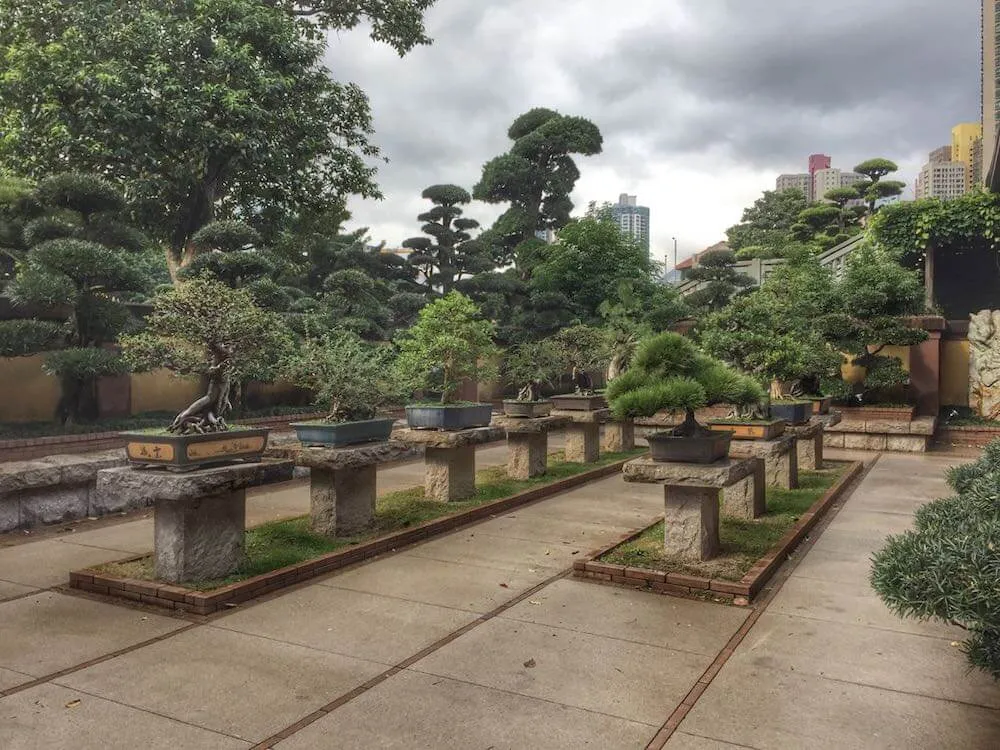
You barely notice the fence or glass panels as they are sympathetic to the overall natural design features of the waterfall and manicured trees. The scale is key with this imitation of nature. A good example of this is when you see a garden with plants that are either too big or too small for the plot. They either look lost or overpowering. If you get this sense in a garden, the scale is wrong.
Chinese garden design relies on imitating nature by using a scale that is sympathetic to the space you’re working with, not too small or too big. In garden design, elements such as specimen trees, plants, and rocks must be to scale in your garden.
Whilst it is a good rule to have a few larger items in a garden rather than lots of small ones, there is a limit to the size of these. The size of any buildings, structures or existing trees in the garden can establish the scale. By applying this to any garden design you can avoid that twee or overwhelming reaction from the garden.
2. Art of borrowing and interaction (Jiejing)
You may have heard me discussing borrowed views in other articles, and Chinese garden design also relies heavily on this well-established principle. It wants to incorporate surrounding vistas and views into the garden design. Why do this? Surely you want to hide from other views and neighbours? The Chinese don’t fight against different views. They utilise them, and it’s a key skill in any design.
Whilst fencing away other views may be your first port of call, working with them or softening them can actually make your garden feel bigger. The Nan Lian Garden effectively manages the high-rise apartments that could overshadow the garden. However, the design and layout make it appear as if these have been incorporated, thus softening them. The imposing skyline almost disappears into the vista.
3. Art of extension and contrast
Given that you will be recreating nature in miniature, the third design principle is all about discovery and journey in the garden. The principle is to encourage people to wonder, ‘What’s around that corner?’ or ‘What is over there?’. It is about leading your guests around the garden with paths, focal points or curious journeys. Rather than the path just leading from A to B, Chinese gardens will feature either trees or rocks along the way to slow down the journey.
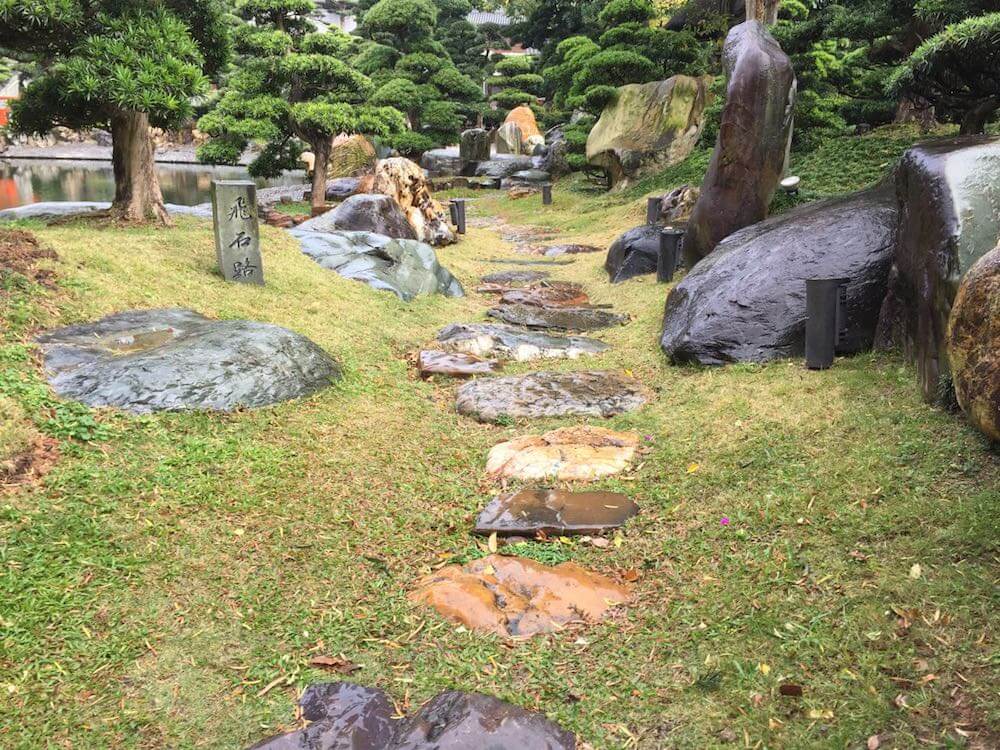
Als,o by carefully placing features such as rocks or buildings in the distance, you can develop this extension to guide your visitors around the garden design. Stone is used to provide an informal path, giving drama to the garden, wondering where it leads to!
4. Aesthetics of resonance
This final design point is tricky to explain and would probably be more reserved for the die-hard Chinese design followers. It’s a real head-scratcher, so bear with me! It’s about resonance, as in bringing an image or memory to mind whilst in the garden.
Confused, yes, it’s quite abstract, which can be a struggle to articulate. The aesthetics of resonance require carefully placing items to evoke a feeling of a landscape, artwork, or memory in the visitor.
In a Chinese garden design, it may involve arranging rocks to symbolise a significant mountainscape in nature or planting to enrich the imagination, perhaps leading to a daydream of a painting or poem. It’s quite an abstract concept to articulate. So I think I will leave it there. I’m told the Nan Lian garden has the aesthetics of resonance, though, in my limited experience, I can’t say it was obvious!
5. Yin Yang Principles in Garden Design
Chinese gardens embody the Taoist principle of yin-yang by harmonising opposites to create balance and a sense of dynamic equilibrium. Light and shadow are carefully balanced, with shaded areas symbolising tranquillity (yin) and sunlit spaces representing energy and brightness (yang). This interplay creates depth and an ever-changing atmosphere as the day progresses.
The contrast between solid and void is another key feature. Solid elements like rocks and pavilions are paired with open spaces such as ponds and courtyards, reflecting the idea that fullness is only meaningful when balanced with emptiness. Similarly, water and stone are used together to symbolise softness and strength, fluidity and permanence, enhancing the garden’s natural harmony.
Curved and straight lines also reflect yin-yang. Winding paths and zigzag bridges soften the structured forms of walls and pavilions, ensuring the garden feels alive and organic rather than rigid. Quiet, secluded spots encourage introspection, while open, lively spaces provide opportunities for social interaction, blending stillness and activity.
Seasonal changes in the garden further represent yin-yang. Winter’s subdued landscapes highlight yin, while the vibrant growth of spring and summer brings yang energy. This balance is not about symmetry or perfection but about creating a natural, flowing equilibrium that reflects the unpredictability of life and the harmony of opposites.
What’s the difference between a Japanese and Chinese garden?
Now, this is a very contested argument, so I must caveat it. Both styles are actually very different, and I don’t want the Chinese garden mafia or Japanese zen ninjas coming for me. At first glance, you may think they both look similar, but there are some apparent differences.
Japanese gardens are more symbolic and controlled, to the point of absolute control of nature!
A Chinese garden is more about discovery and journey, and even though it may be very manicured, there is less focus on the minute details.
In Japanese gardens even a wooden walkway will be positioned with the groove in a particular direction, with an exacting wood stain and finish.
In a Chinese garden, the wood may be more natural and blend in more with the surroundings. In a Japanese garden, it is evident that it is there for a reason.
Many may argue with my definitions, but I think it’s a good starting point for debate! Why not comment below?
Focal Points in Chinese Garden Design
In the Nan Lian Garden, the main focal point is the octagonal pavilion, which stands in the middle of the octagonal lotus-shaped pond. It is described as a symbol of absolute perfection and fulfilment in all aspects of life, and a blessing to all visitors and painted gold; you can’t miss it. It actually takes your breath away when you see it, which really supports its success as a focal point.
It provides an absolute focus point to the garden and uses traditional wooden joining, where the beams all support themselves. Incredible craftsmanship and worthy of a visit for this alone! A focus point is always a valuable addition to any garden design, and there is no point in having a path that leads nowhere. You can even use multiple focus points to navigate people around the garden.
Pruning is fundamental in this style of garden to help replicate nature on a miniature scale. Shrubs and trees are pruned to show their true perfection. Branches are trained, fading flowers snipped out, unruly lateral shoots are removed, bark cleaned and scrubbed. It’s all about putting your best foot forward and displaying nature to its finest.
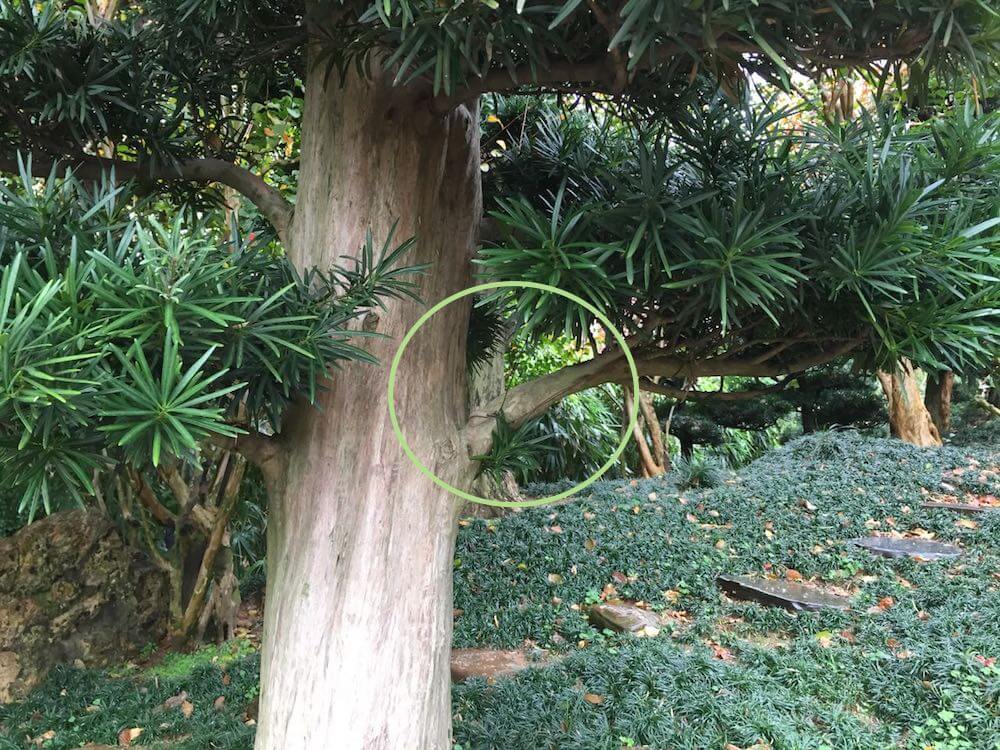
It’s high maintenance and high impact. To show the lengths that the curators of the Nan Lian garden go to, have a look at the pictures below. In the highlighted circles, you may be able to see the training wires used on young shrubs and trees to train them into specific shapes. These wires are used to ensure that laterals, or side shoots, grow out perfectly horizontally, ensuring even spacing in the tree’s ultimate shape. This is man controlling nature to the extreme!
See if you can spot the well hidden training wires
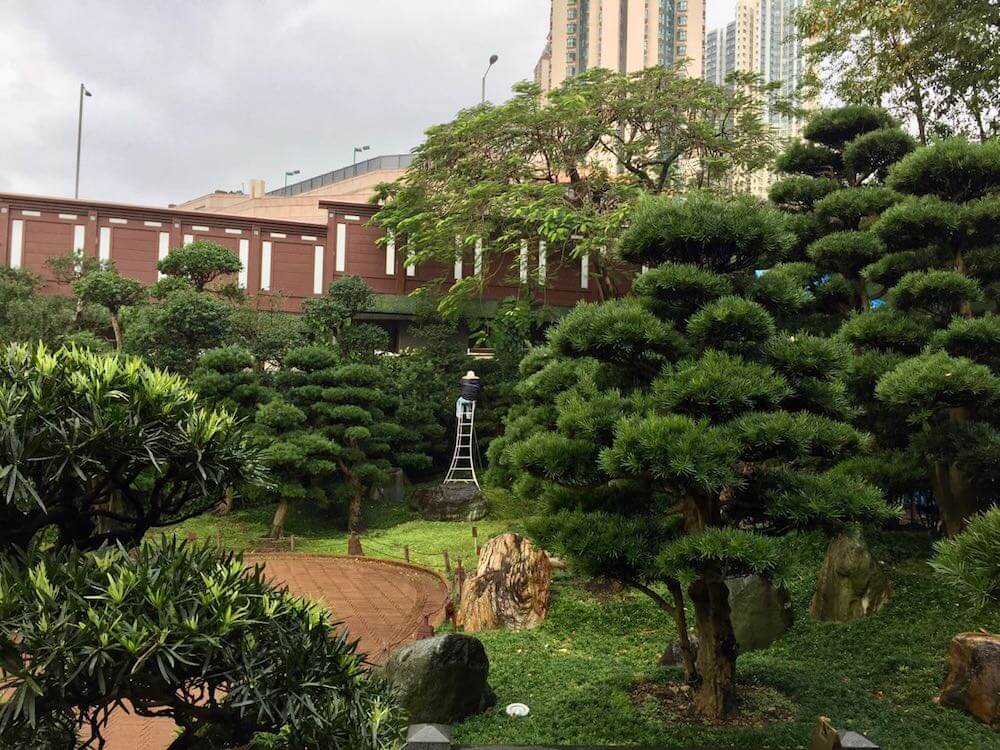
Other areas of the garden I saw were being pruned meticulously by hand by the curators and keeping the shrubs in a state of perfection. By nipping out new growth, they are controlling the ultimate height of the plants and making sure that all the energy and hormones are sent from the top new growth back down to the rest of the plant, ensuring it keeps a fuller, bushier appearance, without ever getting leggy or straggly. It’s a sight to behold and makes me feel incredibly lazy with my ‘as and when’ pruning regime of my own shrubs.
Can you see how each type of tree is roughly the same height and shape? It’s no accident!
If you thought the pruning regime was intense, you should watch the curators as they delicately wash and clean the rocks in the garden. They do this to keep them looking pristine and to ensure they stand out. Moss or pollution are not allowed to set up home on these carefully placed rocks. When you look at them, the veins and mineral strands are so clear to see. Which again draws your attention to the detail and nature of the garden.
Selecting Plants for Chinese Gardens in the UK Climate
Whilst visiting Nan Lian Garden reveals the magnificent possibilities of Chinese garden design, translating these principles to British conditions requires careful plant selection that honours both authenticity and practicality. The good news for UK gardeners is that approximately two-thirds of ornamental plants in British gardens originate from China, meaning you’re already working with an extraordinarily rich palette suited to our temperate climate.
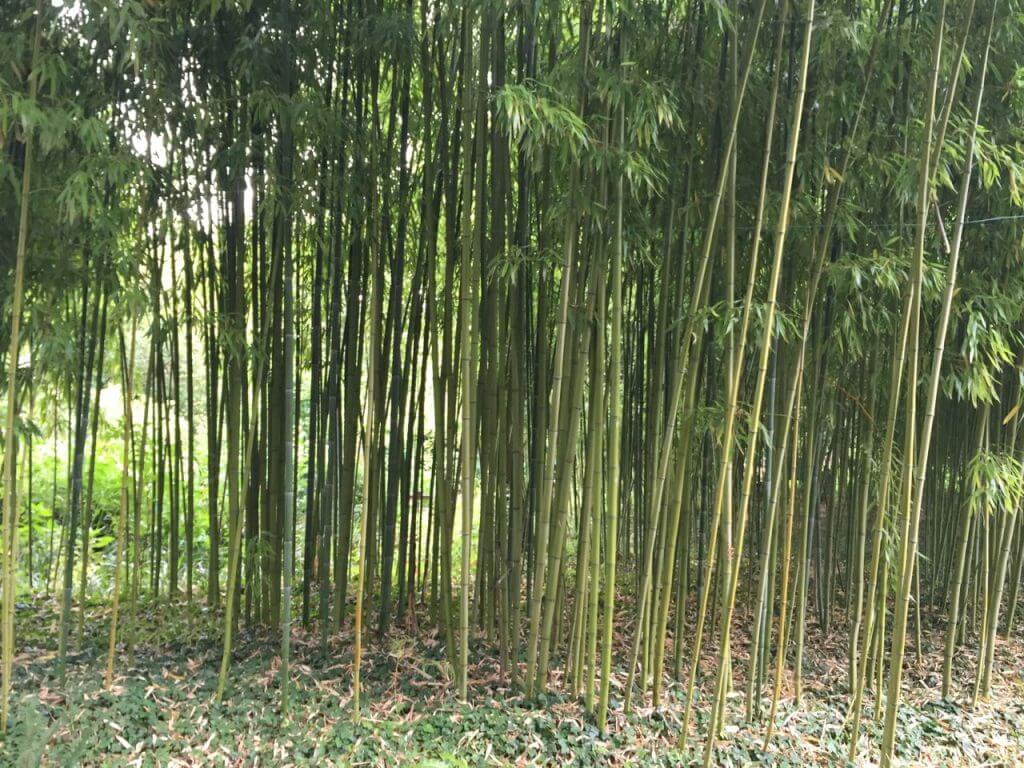
Bamboo inevitably features prominently in Chinese gardens, yet this is where UK gardeners must exercise considerable caution. Whilst running bamboos like Phyllostachys nigra (black bamboo) and Phyllostachys aureosulcata (yellow groove bamboo) create dramatic architectural impact with their coloured culms, they possess aggressively spreading rhizomes that can undermine patios, invade neighbouring properties, and prove nightmarishly difficult to remove.
Instead, I strongly recommend clump forming varieties such as Fargesia murielae and Fargesia nitida, which provide the authentic Chinese aesthetic whilst remaining beautifully behaved. These fountain bamboos create elegant arching forms reaching two to four metres, tolerate our British weather admirably, and won’t trigger disputes with your neighbours or require expensive root barrier installation.
Beyond bamboo, focus on plants that embody the symbolic meanings cherished in the Chinese garden tradition.
Pines represent longevity and endurance, with Pinus wallichiana (Bhutan pine) proving particularly suited to British gardens with its graceful, drooping needles.
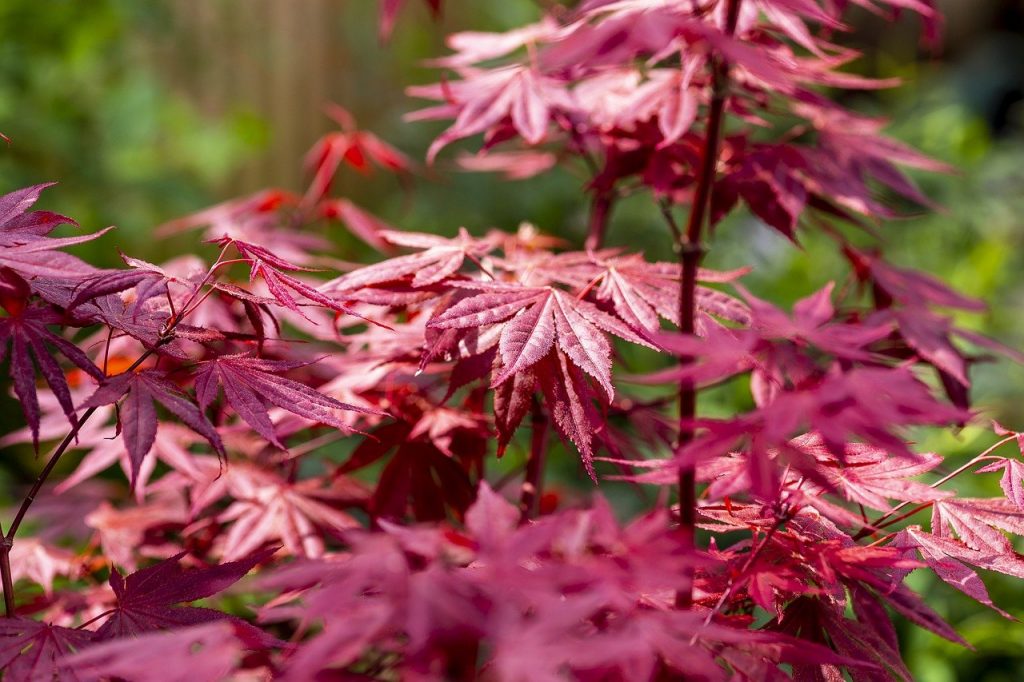
Japanese maples, despite their name, have been cultivated in China for centuries and provide the layered canopy structure essential to Chinese garden composition.
For your understory, consider Fatsia japonica for bold architectural foliage, hostas for their sculptural leaves that complement water features.
Ophiopogon planiscapus ‘Nigrescens’ (black mondo grass) which creates dramatic dark accents.
Plant Name
Key Features & Use in Chinese Gardens
UK Growing Conditions
Fargesia murielae (Umbrella Bamboo)
Non-invasive clumping bamboo, elegant arching form, provides structure and movement
Thrives in partial shade to sun, moist but well-drained soil, hardy to -20°C
Acer palmatum (Japanese Maple)
Despite the name, cultivated in China for centuries, provides layered canopy and autumn colour
Classic flowering climber for pergolas and moon gates, stunning purple racemes
Full sun, any reasonable soil, requires strong support and annual pruning
Remember that Chinese gardens traditionally emphasise structure and form over floral display, favouring a predominantly green palette punctuated by carefully chosen seasonal colour. Chrysanthemums hold particular significance, whilst tree peonies provide spectacular but brief spring drama. The key is restraint, allowing each plant to display its natural form rather than creating the riotous colour tapestries typical of English cottage gardens.
The Essential Role of Rocks & Stone
Rocks represent the bones of the earth in Chinese philosophy, embodying the masculine yang energy that balances water’s feminine yin. Traditional Chinese gardens prize specific stone types for their sculptural qualities and symbolic meanings, with Taihu stones from Lake Tai being particularly treasured for their dramatic perforations and organic forms created by centuries of water erosion. These stones, sometimes costing thousands of pounds for significant specimens, obviously exceed most British gardeners’ budgets, but the principles behind their selection and placement remain entirely accessible.
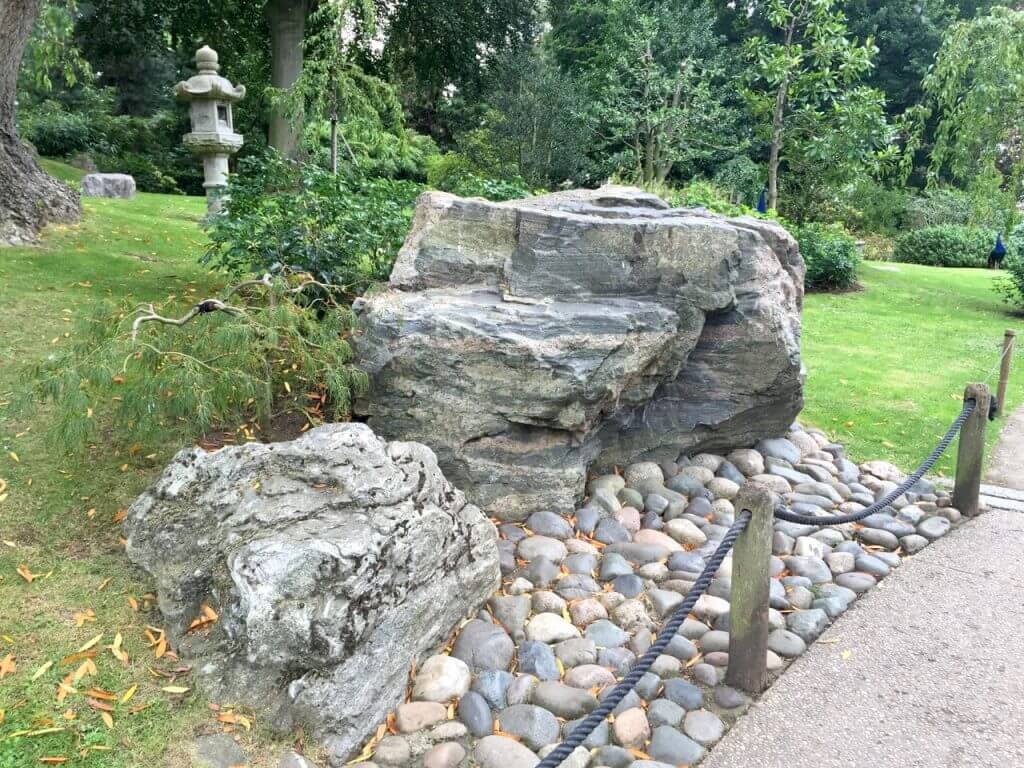
When selecting rocks for your UK Chinese garden, prioritise character over perfection. Seek weathered stones showing interesting textures, mineral veining, or natural sculptural forms rather than smooth, featureless boulders. Local stone often proves most successful, as it naturally harmonises with your regional landscape and typically costs less than imported alternatives.
Visit stone merchants or reclamation yards to find pieces that speak to you, keeping in mind the Chinese concept that rocks should evoke mountains, inspire contemplation, or trigger memories of natural landscapes. A single remarkable stone thoughtfully positioned creates greater impact than numerous mediocre specimens scattered randomly.
Placement of rocks demands considerable attention in Chinese garden design, with individual stones often taking hours or even days to position perfectly. The rock should appear to have always existed in that precise spot, emerging naturally from the landscape rather than obviously placed by human hands. Bury at least one third of the stone to create this grounded appearance, and angle it to display its most interesting face whilst considering how light will play across its surface throughout the day.
Group rocks in odd numbers following Chinese tradition, with three or five stones creating dynamic compositions that avoid the static quality of even-numbered groupings. Remember to leave space around significant stones, allowing them to breathe and command attention rather than crowding them with excessive planting.
Moon Gates: Creating Portals of Discovery
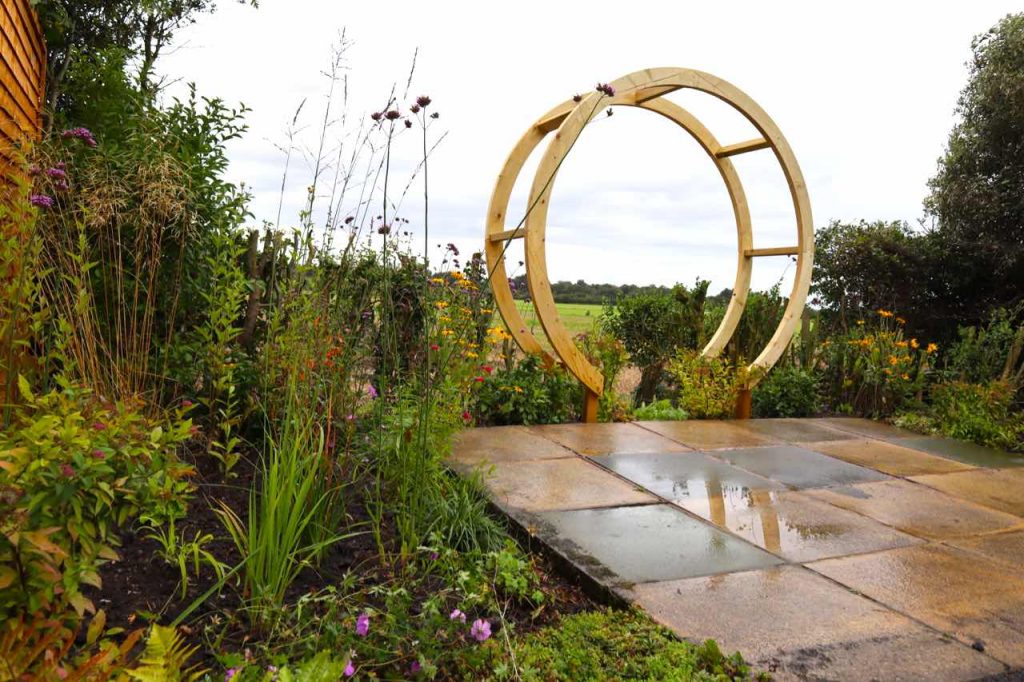
No element of Chinese garden design captures the imagination quite like the moon gate, that perfect circular portal framing tantalising glimpses of the landscape beyond. These yuèliàngmén serve both practical and spiritual functions, acting as formal transitions between garden spaces whilst symbolising birth, renewal, and the completeness of the family unit. The circular form represents the harmony between heaven and earth, and walking through a moon gate traditionally marks passage from the ordinary world into a realm of contemplation and beauty.
For UK gardeners, installing a moon gate presents both opportunities and challenges. Traditional Chinese moon gates were constructed as permanent openings in substantial garden walls using brick or stone, requiring considerable masonry skill and expense.
However, contemporary interpretations offer more accessible alternatives that maintain the essential spirit whilst suiting British gardens and budgets. Freestanding metal moon gates, available in powder-coated galvanised steel or atmospheric Corten steel, can be purchased from specialist suppliers or fabricated locally, typically ranging from £400 to £1,500 depending on size and finish. These work particularly well as thresholds between different garden zones or as striking focal points framing views of specimen plants or water features.
For the committed DIYer, consider constructing a moon gate using cedar or pressure-treated timber, curved around a frame. Achieving a perfect circle will require patience and reasonable carpentry skills. Alternatively, training climbing plants like wisteria, jasmine, or climbing hydrangea over a circular metal framework creates a living moon gate that evolves beautifully through the seasons.
The structure doesn’t need to be enormous to be effective; even a modest 1.2 metre diameter gate creates compelling focus and intrigue. Position your moon gate where it frames a carefully composed view, remembering the Chinese principle of jiejing (borrowed landscape) whereby the gate should reveal something worth discovering, whether a sculpture, a beautiful tree, or a glimpse of your water feature catching the light.
Water Features: The Heart of Chinese Garden Design
Water represents the feminine yin energy in Chinese philosophy, providing essential balance to the masculine yang of stone. More practically, water introduces movement, sound, and reflective light to the garden whilst creating habitat for aquatic plants and wildlife. Traditional Chinese gardens featured substantial ponds, often with elaborate pavilions positioned above or beside the water, but the principles scale beautifully to British gardens of any size.
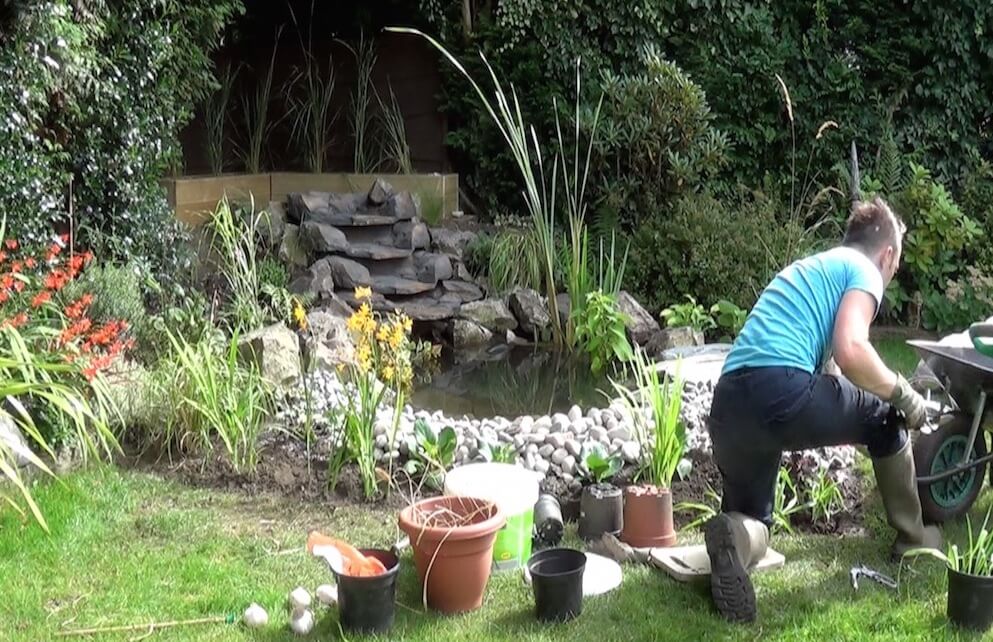
The key to successful water features in Chinese garden design lies in achieving naturalistic forms rather than geometric rigidity. Your pond should follow organic, irregular shapes with varied depths and planting zones, mimicking natural water bodies.
Edge the pond with carefully positioned rocks that appear to emerge organically from the landscape rather than forming obvious borders. In authentic Chinese gardens, these rocks might be precious Taihu stones prized for their sculptural forms and interesting perforations, though similar effects can be achieved in the UK using weathered limestone or large Scottish cobbles arranged with attention to balance and composition.
For smaller British gardens or those working with modest budgets, consider that a Chinese pond can be as simple as a large ceramic vessel or stone trough filled with water and floating lotus or water lilies. This approach maintains philosophical authenticity whilst proving entirely practical for urban courtyards or compact spaces.
Position your water feature where it catches maximum light and provides reflective qualities, remembering the Chinese concept that ponds simultaneously embody emptiness (the void) and fullness (everything they reflect). Install a modest pump or bubbler to maintain water movement and quality, choosing the quietest models to preserve the contemplative atmosphere essential to Chinese garden design. The sound of moving water should whisper rather than shout, creating gentle background music that encourages meditation rather than demanding attention.
Learn Garden Design with Lee Burkhill
What if you are on a budget and would like to design your own garden? My Garden Design for Beginners course is the ideal starting point! With online courses ranging from £29 to £199, there’s something for every aspiring garden designer.
Join me, Lee Burkhill—award-winning garden designer and BBC1’s Garden Rescue presenter—in my most comprehensive course. I’ll guide you step-by-step from a complete beginner to a confident garden designer prepared to create stunning outdoor spaces.
What You’ll Learn:
Design Principles: Understand the key elements that form the foundation of exceptional garden design.
Planting Techniques: Discover how to choose and arrange plants for beautiful, sustainable gardens.
Design Styles & Layouts: Explore a variety of garden styles to suit every outdoor space and personal taste.
Course Features:
20 hours of in-depth study
Flexible online learning at your own pace
Engaging video lessons and interactive quizzes
Real-world case studies to apply your knowledge
Certification upon course completion
This comprehensive course is available now for just £199. Begin your garden design journey today and gain the skills to confidently create breathtaking gardens!
Why not level up your gardening skills with my Garden Design for Beginners course is the perfect place to begin! I offer several courses from £29 to £199 to help you learn the basics of garden design.
29
Garden Design Examples for Small Gardens: 30 Design Templates & Planting Plans
Garden Design Examples for Small Gardens: 30 Design Templates & Planting Plans: In this online gardening course, I’ll walk you through 30 fantastic garden designs, explaining the logic behind the layout, the plant choices, and take-home tips for applying them in your own garden.
Weekend Garden Makeover: A Crash Course in Design for Beginners
Learn how to transform and design your own garden with Lee Burkhills crash course in garden design. Over 5 hours Lee will teach you how to design your own dream garden. Featuring practical design examples, planting ideas and video guides. Learn how to design your garden in one weekend!
Garden Design for Beginners: Create Your Dream Garden in Just 4 Weeks
Garden Design for Beginners Online Course: If you want to make the career jump to becoming a garden designer or to learn how to design your own garden, this is the beginner course for you. Join me, Lee Burkhill, an award-winning garden designer, as I train you in the art of beautiful garden design.
So there we have it, a quick guide to Chinese garden design. My trip to Hong Kong was eye-opening to see some of the styles and practices demonstrated in true Chinese Garden Design. Nam Lian was one of the calmest places in hectic Hong Kong and one of the best-preserved gardens I’ve seen. It’s probably not the kind of detail that most gardeners in the UK can follow without giving up work and becoming neurotic over their garden. However, the interesting principles can be applied to turn your garden into a much more authentic Chinese garden.
Fancy your very own Chinese-style garden? Why not check out my social media, where you can Tweet, Facebook, or Instagram me? Why not visit my YouTube channel for garden design hints and tips? I’d love to hear from you!
Trustindex verifies that the original source of the review is Google.
What a useful consultation we had with Lee this week. In no time he was able to spark a whole host of new ideas and get us started on our journey to create our new garden. In addition to the great chat, Lee printed the photos I had sent him and annotated them with a basic plan. Thanks Lee!
Posted on Google
Joanne Craft-Lane
Trustindex verifies that the original source of the review is Google.
I love Lee's design ideas. Especially helpful was the details on garden path design. I'm currently planning to add a garden path to my garden and this info arrived in my email just in time to help me decide the best choice fir my area and budget! Thanks Lee!
Posted on Google
Nicola Cockram
Trustindex verifies that the original source of the review is Google.
I had a fantastic 1-hour garden consultation with Lee! I had a good vision in my head beforehand, but with Lee’s help, I was able to prioritise and make decisions about what would be most suitable for my space. In such a short time, I learned so much. I had plenty of ideas, and Lee was incredibly helpful in narrowing them down and guiding me towards what I truly wanted. He shared so much valuable theory and knowledge, which was exactly what I needed. By the end of the call, I felt fully equipped with a clear vision and ready to dive into my garden project. We also discussed purchasing courses, and Lee suggested the one that would be best suited to me. I’m so excited to get started! I highly recommend reaching out to Lee – I know I would have made a lot of mistakes without his guidance. Save the money and invest in this consultation!
Posted on Google
Jim Simmonds
Trustindex verifies that the original source of the review is Google.
I love Lee's style, help and the fact he is always happy to share his knowledge. No other expert does this so willingly. Love all the videos tutorials too which is such a help and such a generous thing to do - thank you Lee.
Posted on Google
Val Smith
Trustindex verifies that the original source of the review is Google.
I had a one-hour consultation with Lee and during that time he gave me loads of creative ideas and advice for the re-design of my garden which I had been struggling to sort out. He was engaging, knowledgable and informative and followed up with lots of useful info on email afterwards. Thank you for the inspiration and can't wait to get started....sorry for the black screen you had to look at due to my technical incompetence..hopefully my gardening skills will be better!!
Posted on Google
Sarah Howling
Trustindex verifies that the original source of the review is Google.
We had a one-hour consultation with Lee and it was brilliant. He is as warm, inspirational, knowledgeable, and funny as he is on the TV. We had loads of questions and Lee answered them all and we left with a really clear plan of what to do.
Lee followed up the next day with lots of resources and the sketched out plan of our garden that he drew when we were online. I can't recommend Lee or the one-hour consultation enough. Thanks, Lee!
Posted on Google
caroline barnes
Trustindex verifies that the original source of the review is Google.
The hour we spent with Lee was extremely valuable and helpful. He was friendly, constructive, knowledgeable and genuinely interested in our project. Lots of great ideas and tips - we can’t wait to get started. Would absolutely recommend.
Posted on Google
John Barnes
Trustindex verifies that the original source of the review is Google.
Very helpful and genuinely interested in helping with our project. Very worthwhile investment of both time and money.
Posted on Google
Sue Prior
Trustindex verifies that the original source of the review is Google.
So engaging and keep learning more about horticulture + hope to continue doing so. Thanks
Load more
Verified by Trustindex
Trustindex verified badge is the Universal Symbol of Trust. Only the greatest companies can get the verified badge who has a review score above 4.5, based on customer reviews over the past 12 months. Read more
Lee Burkhill
Lee Burkhill, known as the Garden Ninja, is an award-winning garden designer and horticulturist with over 30 years of gardening experience and 15 years as a professional garden designer. A qualified RHS (Royal Horticultural Society) professional, Lee specialises in sustainable garden design and practical horticultural advice. He designs and presents on BBC1’s Garden Rescue and in leading gardening publications. Lee combines three decades of hands-on gardening knowledge with professional design qualifications to help gardeners create beautiful, functional outdoor spaces.