Can AI Design My Garden? The Truth About Artificial Intelligence Garden Design Tools
Lee Burkhill: Award Winning Designer & BBC 1's Garden Rescue Presenters Official Blog
Beginner level
AI garden design tools promise instant transformations, but can they actually create a garden that works? I've tested these algorithms and found they ignore crucial factors like soil type, aspect, and realistic plant choices. Here's why AI garden designs fail and what you actually need for success.
“Can AI Be Used to Design My Garden?”
I get asked this question almost weekly now. Someone’s uploaded a photo of their sad patch of lawn to an AI garden planner, pressed a few buttons, and suddenly they’re staring at a rendered image of what looks like the Chelsea Flower Show has landed in their backyard. The question they really want answered is this: can I actually build this? And more importantly, should I?
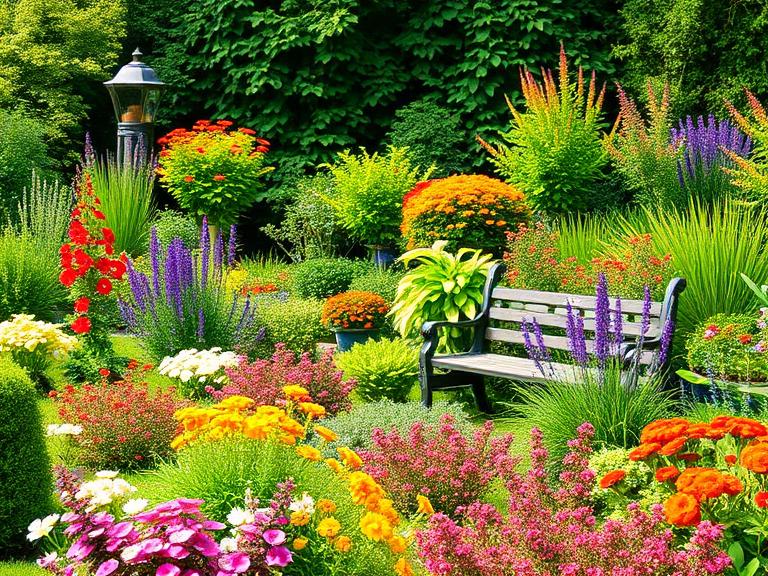
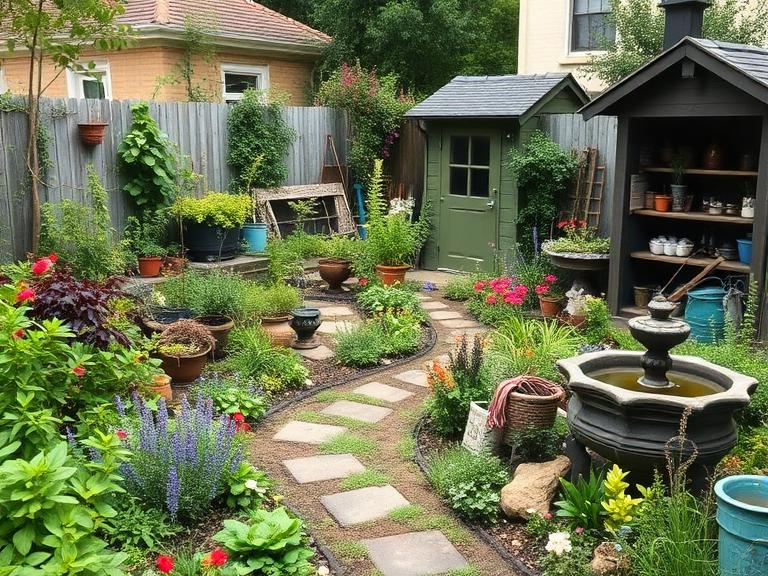
The short answer is no. Not yet, anyway. And probably not for a good long while. I mean, look at the image above. At first, it seems like a garden, then you realise that none of those plants actually exist or really grow that way or to that size!
Let me explain why, and trust me, I’ve seen enough AI-generated garden disasters to fill a book.
The Shiny Promise of AI Garden Design
Look, I understand the appeal. You’re scrolling through your phone, you see an advert for an AI garden design tool, and it promises you the world.
Upload a photo, choose a style (Japanese zen, Mediterranean paradise, English cottage, you name it), and within seconds you’ve got a beautiful image of your transformed outdoor space. Some of these tools claim to identify your plants, suggest climate-appropriate species, and even provide planting schedules.
For free, or a tenner a month. Compared to hiring a garden designer who’ll charge you anywhere from £250 to several thousand pounds, it sounds like an absolute bargain.
The technology looks impressive on the surface. These AI tools utilise something called generative models, which is essentially a sophisticated way of saying they’ve been trained on thousands of garden images and taught to remix them based on your request.
Some tools like Rescape AI, Neighborbrite, and AI Garden Planner have garnered thousands of users, all hoping to visualise their dream gardens without breaking the bank or getting their hands dirty with the actual planning work.
But here’s where the gloss starts to wear off, and quickly.
Where AI Garden Design Falls Flat on Its Face
The fundamental problem with AI garden design is that it doesn’t actually understand gardens. It understands pictures of gardens, which is about as useful as knowing what a car looks like without understanding how an engine works. Let me break down where these tools consistently fail, and why they’re leaving frustrated gardeners with unusable “designs” that belong more in the realm of fantasy than reality.
AI Hasn’t Got a Clue About Your Soil
I cannot stress this enough: soil is everything in gardening. You could have the most stunning design in the world, but if you’re trying to grow acid-loving azaleas in alkaline chalk soil, or Mediterranean lavender in heavy clay that sits waterlogged all winter, you’re setting yourself up for heartbreak and a dead garden.
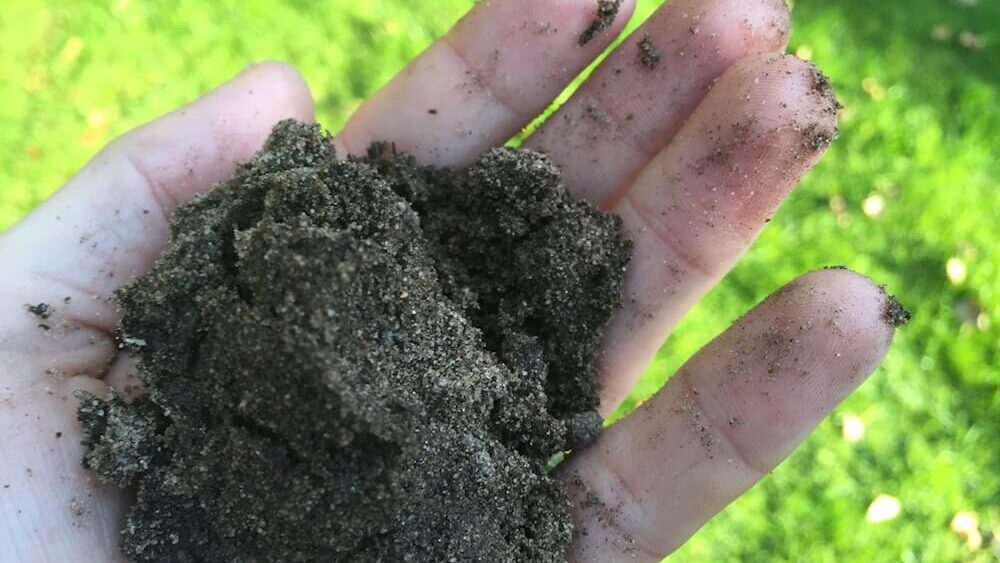
AI tools don’t test your soil. They can’t. They don’t know if you’re dealing with sandy soil that drains like a sieve, heavy clay that’s like concrete in summer and a swamp in winter, or lovely loam that plants adore.
Some claim they consider climate zones, but even that’s surface-level at best. I’ve seen AI suggest Rhododendrons for gardens in chalky soil areas, which is like suggesting someone keeps tropical fish in the North Sea. It’s fundamentally incompatible with the conditions, and no amount of pretty rendering will change that basic fact.
When I design a garden, one of my first questions is always about soil type. I‘ll often recommend a soil test because, without understanding what you’re working with, you’re essentially gambling with every plant choice. AI skips this entirely and just generates whatever looks pretty in the style you’ve selected.
Aspect? What Aspect?
Here’s another critical factor that AI completely ignores: aspect. That’s the direction your garden faces, and it determines everything from which plants will thrive to where you can actually sit comfortably on a summer evening. A north-facing garden in Manchester gets vastly different light to a south-facing one, and the plants that’ll succeed in each are completely different.
AI doesn’t know your aspect. It can’t tell from a photo whether that shadowy corner is in shade because you took the photo at 4pm in November, or because it’s a north-facing plot that never sees direct sun. I’ve watched AI suggest full-sun Mediterranean plants for areas that are clearly beneath tree canopies or overshadowed by buildings. It’s generating based on aesthetic appeal, not horticultural reality.
A proper garden designer will visit your site at different times of day, observe where the sun hits, identify frost pockets, and work out which areas get hammered by wind. These factors aren’t glamorous, but they’re the difference between a garden that flourishes and one that limps along before giving up entirely.
Plant Selection: A Comedy of Errors
This is where AI garden design truly enters the realm of fiction. I’ve seen AI tools suggest plant combinations that would make any self-respecting horticulturist weep. Not just inappropriate choices for the conditions, but plants that literally don’t exist, or varieties that can’t be grown in the UK climate.
One client showed me an AI-generated design that featured something called “Helianthus celestialis” (which isn’t a real plant, by the way) alongside “winter-blooming forsythia” (Forsythia blooms in spring, that’s literally its whole thing) and “dwarf giant bamboo” (which is an oxymoron of spectacular proportions).
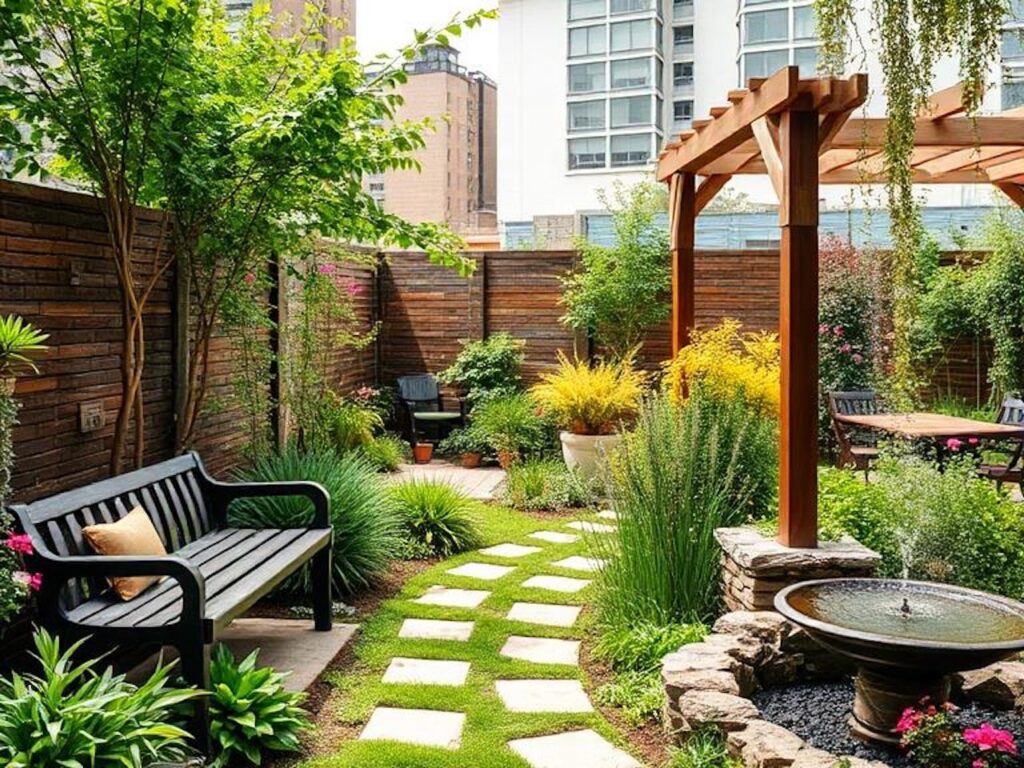
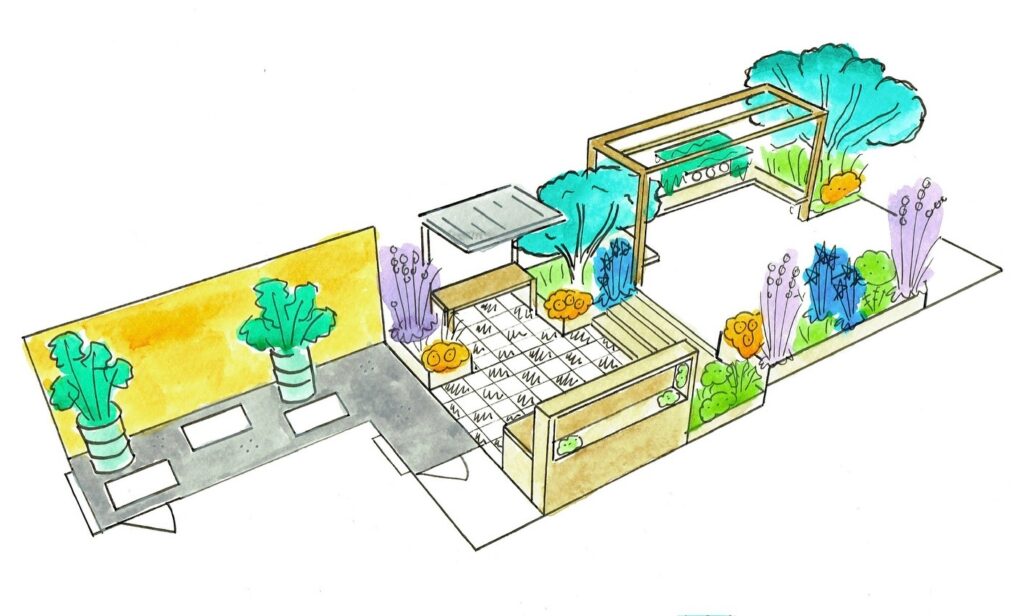
The AI had essentially made up plant names that sounded plausible, combined with real plants at the wrong times of year, creating a botanical impossibility masquerading as a garden plan. In the example below, ignoring the block of flats behind the garden, I have no idea what the plants are as they can;t be identified and many have mixed plant parts from different species!
Even when AI does suggest real plants, it rarely considers mature size, growth habits, or whether they’ll compete with each other. I’ve seen designs with aggressive bamboo placed next to delicate perennials, or plans that pair acid-lovers with lime-lovers, or shade plants with sun worshippers. It looks lovely in the rendering where everything’s the same size and miraculously not killing each other. Reality is somewhat different.
Zero Spatial Awareness or Proportion
AI’s understanding of three-dimensional space is, to put it charitably, creative. I’ve seen rendered designs that show perfectly manicured circular lawns in rectangular gardens, water features that would require excavating your neighbour’s conservatory to fit, and raised beds that appear to defy the laws of physics by somehow being both higher and lower than the surrounding ground level.
I like the fact that the garden above has a shed that merges into the fence line and also a path that doesn’t actually reach the shed.
One particularly memorable example featured a garden with a “gently sloping lawn” that would have required either moving several tonnes of soil or installing retaining walls, which weren’t shown in the design.
Another featured a “winding path” that wound directly through where the render showed a tree growing. It’s as if the AI designed two separate gardens and then just layered them on top of each other without checking if they’d actually work together.
Professional designers use their brains and often proper surveying to understand levels, drainage, access points, and how spaces actually connect. AI makes it look pretty and hopes you won’t notice that the steps leading to your patio would actually deposit you directly into a flowerbed.
Why Generic Ideas Lead to Garden Disappointment
AI is brilliant at generating ideas, but utterly hopeless at tailoring them to your specific plot.
Every garden is unique. It’s not just about soil and aspect, though those are crucial. It’s about your existing features, your maintenance capacity, your budget, how you actually want to use the space, and dozens of other factors that make your garden yours. This is where human-led scaled garden design cannot be beaten.
AI gives you generic templates dressed up in pretty renders. It doesn’t know that you’ve got a toddler who needs safe play space, or that you’re out at work all day and need low-maintenance solutions, or that you’re dealing with a neighbour’s overhanging tree that dominates half your plot. It can’t factor in your budget constraints, or the fact that you’re planning an extension next year, or that your elderly parent needs level access throughout the garden.
I’ve spoken to so many disappointed gardeners who’ve followed AI suggestions and ended up with expensive failures. They’ve bought plants that look similar to the made-up ones that promptly died, installed features in completely wrong locations, or created designs that looked nothing like the AI render because, surprise, surprise, real gardens don’t have perfect lighting and Instagram filters.
The disappointment isn’t just about wasted money (though that stings), it’s about the loss of time and the disillusionment that comes from realising you’ve been sold a fantasy.
One gardener told me they’d spent over £800 on plants suggested by an AI, only to watch most of them struggle through a single year before dying. The AI hadn’t accounted for their heavy clay soil, their exposed site, or their particularly harsh microclimate. A proper consultation would have flagged these issues immediately and saved them hundreds of pounds and months of frustration.
The Fictional Garden Problem
Let me share some of my favourite examples of AI garden design at its most creative. I’ve kept screenshots of these because they’re simultaneously hilarious and cautionary.
There was a design featuring:
“Perennial annuals” (which by definition cannot exist)
“Deciduous evergreens” (same problem)
A plant labelled as “Clematis perpetua grandifolia” which doesn’t exist but sounds impressive if you don’t know your Latin botanical names.
Paths that would be impossible to use
Dimensions that far exceeded the scale of the garden
The AI had basically invented plants that fit the aesthetic it was going for, seemingly unaware that gardeners would actually need to source these mythical species.
Then there are the structurally impossible designs. I’ve seen AI suggest pergolas that span distances requiring steel engineering, decking that appears to float in mid-air with no visible support structure, and my absolute favourite: a sunken garden design for a plot that was clearly on a slope, which would have required either massive retaining walls or basically building a swimming pool and calling it a garden room.
One client showed me an AI design that featured a “water rill” (a narrow decorative channel of water) that somehow flowed uphill, defying both gravity and common sense. Another had a circular patio that was supposedly 15 feet in diameter, but would have actually taken up the entire garden based on the photo’s scale. The AI had no concept of actual measurements or how things work in physical space.
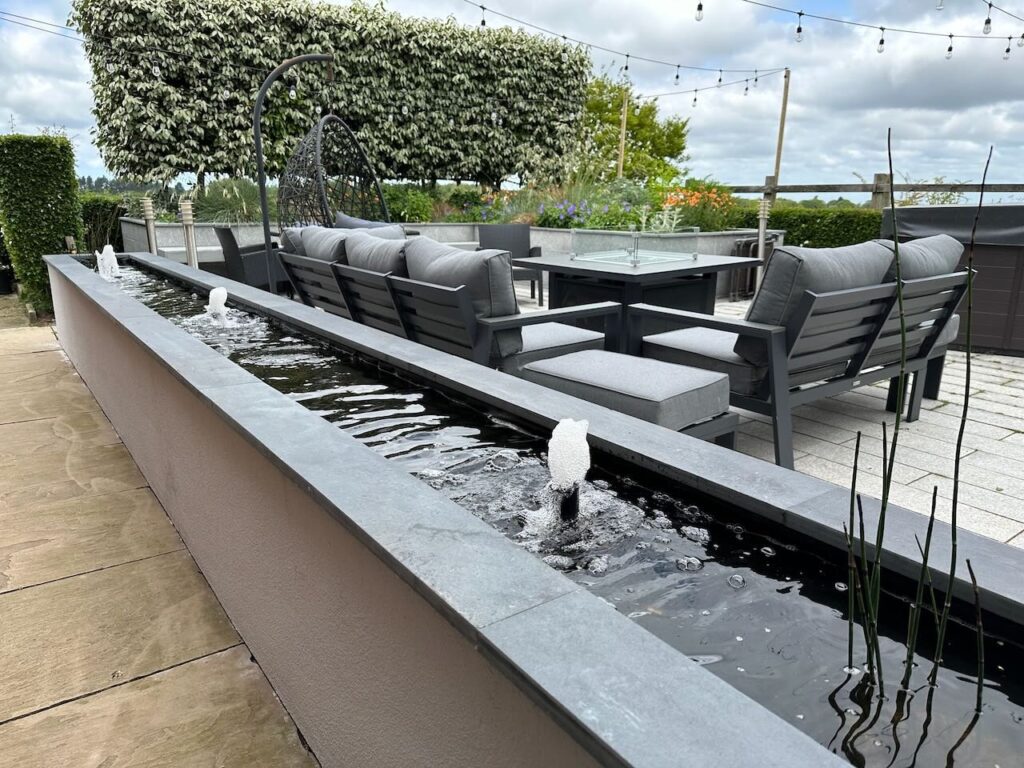
Below is an example of a real rill, designed by me in a real (non-AI) garden.
These aren’t just minor errors that can be worked around. They’re fundamental flaws that render the designs useless as actual plans you could hand to a landscaper. And that’s before we even get into questions like drainage, which AI comprehensively ignores despite it being absolutely critical to garden success.
When AI Tries to Be a Landscape Architect
Some AI tools claim to handle the technical aspects of garden design, including suggesting materials, estimating costs, and providing construction details. Having reviewed many of these outputs, I can confidently say they’re nearly always ‘guestimates’.
I’ve seen AI suggest York stone paving (one of the most expensive materials) with cost estimates that wouldn’t cover a single square metre at current prices. I’ve seen recommendations for “easy DIY projects” that would require mini-excavators, multiple skips, and probably planning permission. One tool suggested building a retaining wall as a “simple weekend project” without mentioning the need for foundations, drainage, or the fact that anything over a certain height needs structural engineering in the UK.
The construction sequences are equally bonkers. I’ve seen designs that suggest laying a lawn, then building a patio on top of where the lawn was just laid. It’s clear the AI understands what elements go into gardens but has no clue about the actual process of building one.
What AI Can (Sort of) Do
To be fair, AI isn’t entirely useless for gardens. If you’re looking for loose inspiration, the kind of “wouldn’t it be nice if we had a water feature” or “I quite fancy a Japanese aesthetic” level of vague ideation, then AI image generators can provide starting points. They’re essentially fancy mood boards, and there’s nothing wrong with using them that way.
Some people find them helpful for communicating rough ideas to an actual designer. If you can’t quite articulate what you want but you’ve got an AI render that captures a vibe, that can be useful as a jumping-off point for a real conversation about what’s actually achievable in your space.
But that’s about where the usefulness ends. Using AI as your primary design tool is like using a painting of a car as your vehicle. It might show you what cars can look like, but you can’t actually drive it anywhere.
Garden Design AI Tools
If you want to play around and see what good or bad designs AI can provide you, then below is a list of the most common AI garden design tools. Though you have been warned about the accuracy and expertise of said tools!
Free/Freemium AI Garden Design Tools
Rescape AIhttps://rescapeai.com Upload photos and generate garden designs in various styles. Credits from £6.50 ($8.99) for 125 images.
Neighborbritehttps://neighborbrite.com Free basic version, AI-powered landscape design with style templates. Pro features available on subscription.
AI Garden Plannerhttps://aigardenplanner.com Over 50 garden styles including themed options. Free trial available, then from £6.50/month ($9/month yearly).
MyGardenGPThttps://mygardengpt.com Free to start, plant identification and climate-specific recommendations. Premium unlimited generations available.
Ogrovision (AI Garden Design)https://aigarden.design Free account to start, AI plant recognition and care recommendations. Uses ChatGPT technology option.
Microsoft Copilothttps://copilot.microsoft.com Free AI assistant with DALL-E 3 integration for garden visualisations and planning advice.
Professional/Paid AI Tools
HomeDesigns AIhttps://homedesigns.ai/landscaping-ai Comprehensive home design platform including gardens. Free trial available, subscriptions from around £10/month.
Ideal House Landscapinghttps://ideal.house/landscaping AI landscape design with climate-aware suggestions. Free basic use, premium features available.
DreamzAR Available as mobile app only (iOS/Android). Augmented reality features. Subscription approximately £15-18/month.
Fotor AI Landscape Generatorhttps://www.fotor.com General AI image generator that can create garden concepts. From approximately £9/month.
Note on These Tools
As covered in the article, while these tools can provide inspiration and rough visualisations, they consistently fail to account for critical factors such as soil type, aspect, drainage, and realistic plant selection for UK conditions. They’re best used as mood boards rather than actual garden plans.
Why You Actually Need an Expert
Here’s what a proper garden designer brings that AI simply cannot: experience, knowledge, and the ability to view your garden with human eyes that understand its context. When I visit a site, I’m assessing dozens of factors simultaneously.
I’m looking at soil, aspect, drainage, existing plants, microclimates, access points, how the space connects to your home, what your neighbours have that might impact your plot, local wildlife, and about fifty other things that AI hasn’t even been programmed to consider.
I can tell you which plants will work and which won’t, not because I’ve memorised a database, but because I’ve grown thousands of plants over decades and know how they behave in British conditions. I can spot problems before they happen. I can design around your budget, your time constraints, your physical abilities, and your actual lifestyle rather than some idealised version of it.
A good garden designer also brings problem-solving skills.
That shady, damp corner? I can make it a feature with the right plant choices.
That awkward narrow side passage? I can turn it into a productive space or a gorgeous shade garden.
The ugly view of your neighbour’s shed? I’ve got solutions. AI just generates pretty pictures and hopes you won’t notice the problems.
Most importantly, a garden designer creates a plan that can actually be built and maintained. We specify real plants from real suppliers, suggest appropriate materials that fit your budget, provide construction details that contractors can work from, and create designs that develop and mature over time rather than looking good for five minutes before falling apart.
29
Garden Design Examples for Small Gardens: 30 Design Templates & Planting Plans
Garden Design Examples for Small Gardens: 30 Design Templates & Planting Plans: In this online gardening course, I’ll walk you through 30 fantastic garden designs, explaining the logic behind the layout, the plant choices, and take-home tips for applying them in your own garden.
Weekend Garden Makeover: A Crash Course in Design for Beginners
Learn how to transform and design your own garden with Lee Burkhills crash course in garden design. Over 5 hours Lee will teach you how to design your own dream garden. Featuring practical design examples, planting ideas and video guides. Learn how to design your garden in one weekend!
Garden Design for Beginners: Create Your Dream Garden in Just 4 Weeks
Garden Design for Beginners Online Course: If you want to make the career jump to becoming a garden designer or to learn how to design your own garden, this is the beginner course for you. Join me, Lee Burkhill, an award-winning garden designer, as I train you in the art of beautiful garden design.
Can AI be used to design your garden? Technically, yes, in the same way you could technically use a chocolate teapot. It exists; you could attempt it, but the results will be disappointing and possibly messy.
AI garden design tools are, at best, idea generators. They’re not substitutes for professional design, and treating them as such is a recipe for wasted money, dead plants, and gardens that never quite work. They can’t assess your specific conditions, they regularly suggest plants and features that are inappropriate or impossible, and they provide renders that look beautiful but bear little resemblance to what you’ll actually end up with if you try to build them.
If you’re serious about creating a garden that works for your space, your lifestyle, and your budget, you need expertise that understands horticulture, design principles, construction realities, and the specific quirks of British gardening. You need someone who can tell you why your grand plans won’t work, but here’s what will, or who can take your vague ideas and turn them into something buildable and beautiful.
AI will guess for you, and guesses in gardening are expensive. Expert design might cost money upfront, but it saves you vastly more in the long run by getting things right the first time. Your garden deserves better than algorithmic guesswork dressed up in fancy renders.
If you’re ready to create a garden that actually works rather than one that just looks good in an AI-generated fantasy, get in touch. I’ve been designing gardens for over 15 years, growing plants for 35 years, and I’ve yet to suggest a plant that doesn’t exist or a pergola that defies the laws of physics. That might not sound revolutionary, but apparently, it’s more than AI can manage.