Why Are My Conifers Dying and Turning Brown? Complete Diagnostic Guide
Lee Burkhill: Award Winning Designer & BBC 1's Garden Rescue Presenters Official Blog
Beginner level
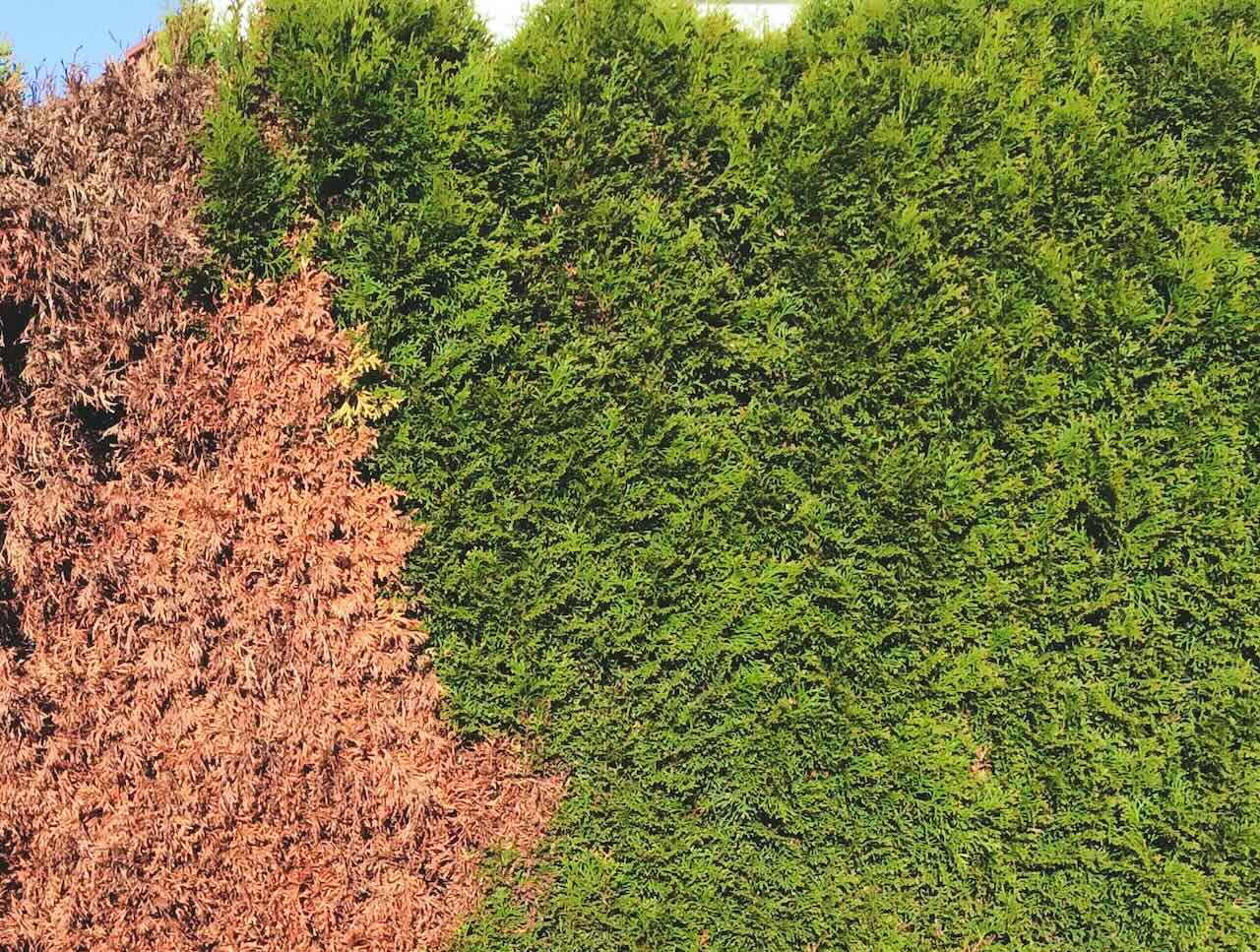
Conifers turning brown sends most gardeners into panic mode, convinced their evergreen screening is doomed. The brutal truth is that browning rarely reverses, but understanding whether you're dealing with root rot, pests, fungal disease, drought stress, or pruning damage determines whether your conifer survives or needs replacing entirely. Let me show you how to stop conifers turning brown!
Quick Answer: Dying Conifer Diagnosis
Conifers turning brown typically indicate one of five problems:
Poor hard pruning back to old wood
Root rot from waterlogged soil (entire plant affected)
Pest infestation (patches or sections)
Drought stress (browning from tips inward)
Fungal disease (random patches with unusual discolouration).
Avoid hard pruning back to old wood, then check soil drainage, as overwatering or heavy clay kills more conifers than any other cause. Improve drainage, remove affected portions, and ensure adequate spacing for air circulation. Most fungal problems cannot be reversed, but surviving green growth remains viable.
Why Conifers Succumb to Browning Problems
Through years of BBC Garden Rescue site visits and answering countless desperate questions on the Garden Ninja forum, I’ve learned that dying conifers represent one of the most distressing garden problems homeowners face. Unlike deciduous plants that can shed leaves and regrow them, evergreen conifers show damage that remains visible for years, and because many varieties grow slowly, recovering from problems or replacement requires patience most gardeners find challenging.
The fundamental issue with diagnosing conifer problems is that multiple different causes can produce similar brown, dead foliage. A waterlogged Leylandii hedge, a drought-stressed Thuja, and a pest-infested Juniper can all present with brown needles, yet they require completely different treatments. Applying the wrong solution not only wastes time and money but often makes the underlying problem worse, accelerating the decline.
British weather patterns create particular challenges for conifers. Our wet winters cause root rot in heavy soils, whilst occasional hot, dry summers stress shallow-rooted varieties. The temperature fluctuations common in UK gardens stress conifers adapted to more stable climates. Add in increasingly common pest problems like conifer aphids and scale insects, and you have a perfect storm of factors that can turn your once-green evergreen screen into a brown eyesore.
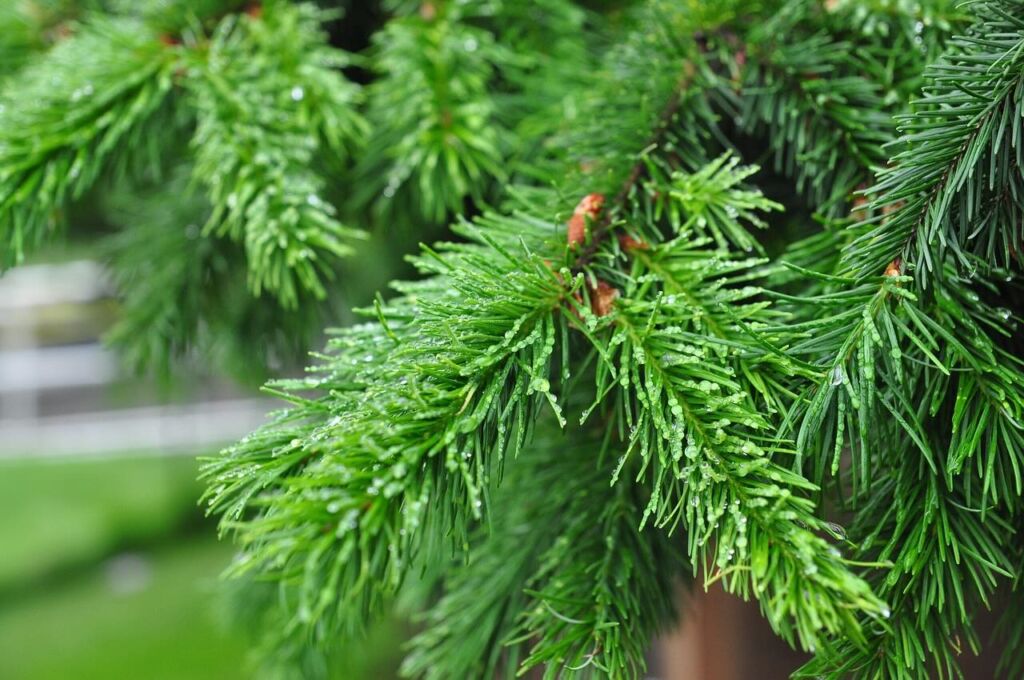
I think conifers get a bad reputation, they are really a fantastic genus of plant for wildlife, privacy and helping provide wind breaks for exposed gardens, if you haven’t already seen my conifer guide then do check that out after this guide.
1) Why Conifers Cannot Recover from Severe Pruning
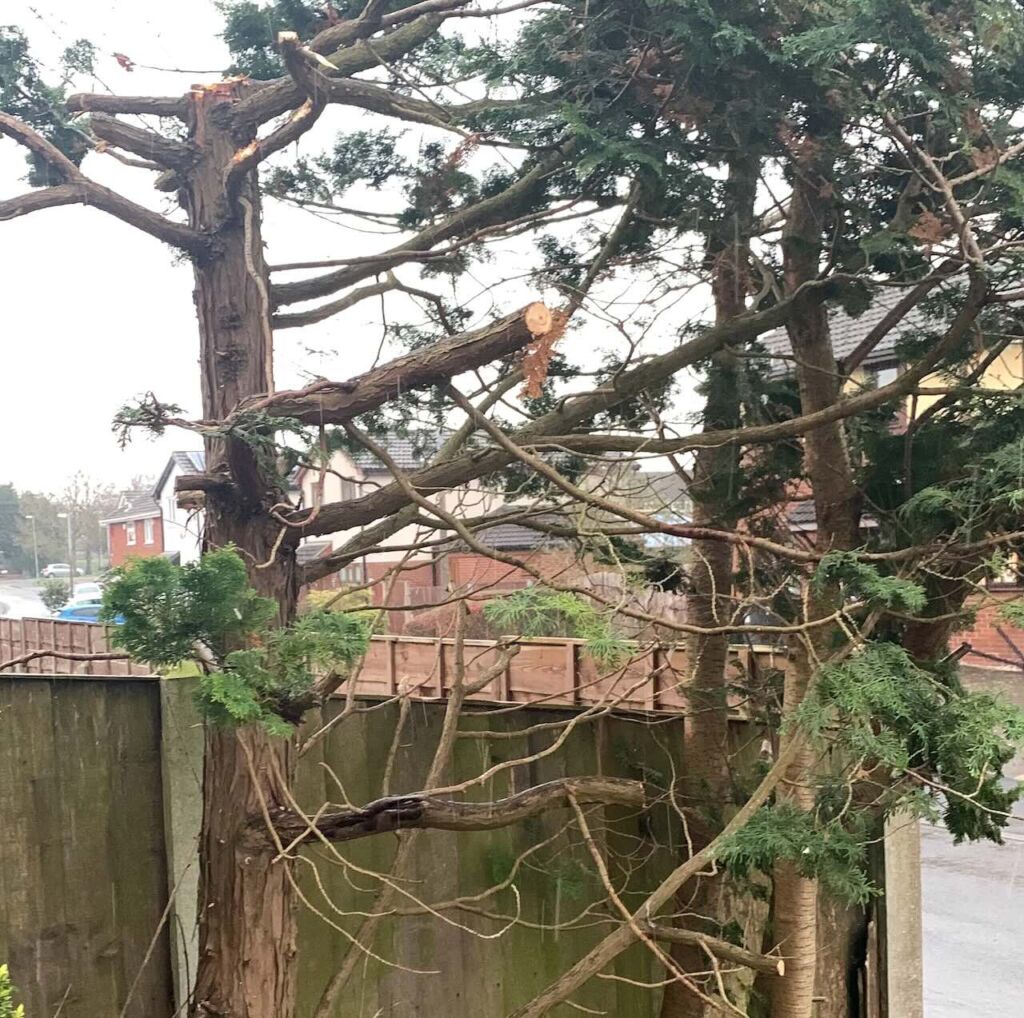
One of the most heartbreaking conifer failures I witness regularly comes not from disease or pests but from well-intentioned gardeners who simply don’t understand how differently conifers respond to pruning compared to deciduous shrubs. Unlike your typical garden shrub that cheerfully regrows from old wood after hard pruning, most conifers possess virtually no dormant buds on their older, brown interior wood. When you cut back past the green, actively growing foliage into this bare brown wood, you’ve removed the plant’s only capacity to produce new growth on that branch.
The science behind this limitation relates to how conifers allocate their growth resources. Deciduous plants maintain numerous dormant buds along their stems as an evolutionary insurance policy against damage. Conifers, being evergreen, evolved in environments where their foliage typically remains intact year round, so they never developed this same regenerative capacity. They maintain their needles for years rather than shedding them seasonally, which means they invest far less in backup growth points along older stems.
Recognising Conifer Pruning Damage
Hard pruning damage appears immediately and dramatically. Areas cut back to bare brown wood remain bare, creating obvious dead brown sections that stand out starkly against any remaining green growth. Unlike disease or pest problems that develop gradually over weeks, pruning damage appears overnight, making the cause obvious if you know what you’re looking at.
The frustration multiplies when gardeners, seeing these brown sections, assume the plant is diseased and prune harder, removing more material in hopes of finding healthy wood. This only creates larger dead zones. I’ve attended sites where entire leylandii hedges have been reduced to bare brown trunks by this logic, with desperate homeowners hoping for regrowth that will simply never materialise.
The Point of No Return
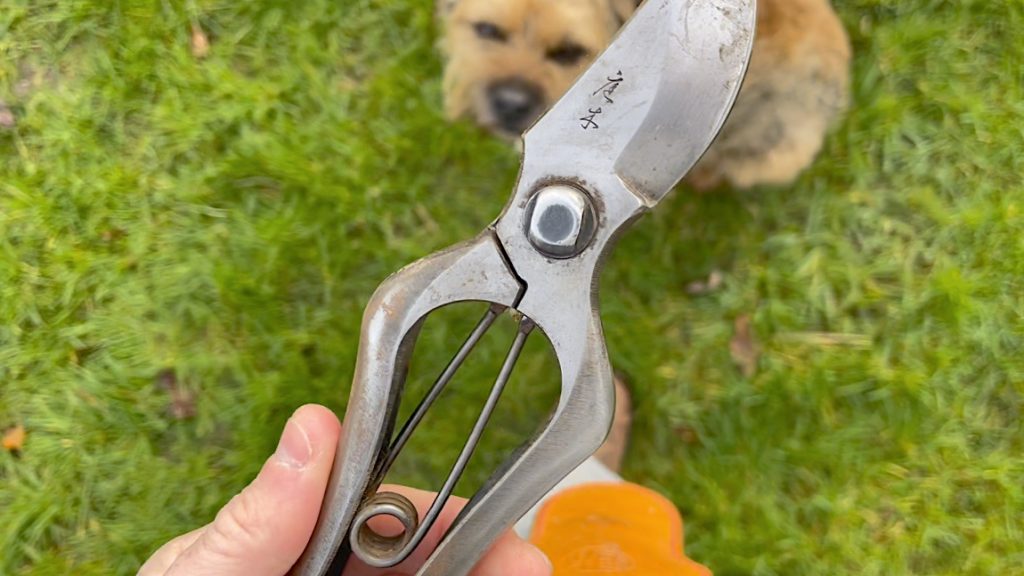
Understanding where green growth ends and old wood begins is absolutely critical before making any pruning cuts on conifers. Run your hand along branches from the tips inward. You’ll feel soft, pliable green growth near the tips, then encounter increasingly woody, hard brown stems as you move toward the trunk. That transition point represents your absolute limit for pruning cuts if you want the branch to remain alive and capable of producing future growth.
Some conifers, particularly yew and to a lesser extent some thuja varieties, break this rule and can regenerate from old wood, but these are exceptions rather than the rule. Unless you’re absolutely certain your specific conifer species can handle hard pruning, assume it cannot and prune conservatively, staying well within the green growth zone.
Prevention Through Proper Hedge Management
Conifer hedges become problems precisely because gardeners let them grow too large before attempting control, then discover they cannot reduce them without cutting into old wood. The solution requires regular trimming from establishment onward, maintaining hedges at your desired size by removing only current season’s growth each year. This keeps cutting within the green zone whilst preventing the gradual expansion that eventually forces hard pruning.
If your conifer hedge has already outgrown its space and needs significant reduction, accept that you cannot achieve this through pruning. Your options become living with the oversized hedge, replacing it with more appropriate plants, or creating screening through alternative methods. Attempting hard pruning will leave you with dead brown sections that remain visible for years or require complete removal anyway.
2) Root Rot: The Silent Conifer Killer
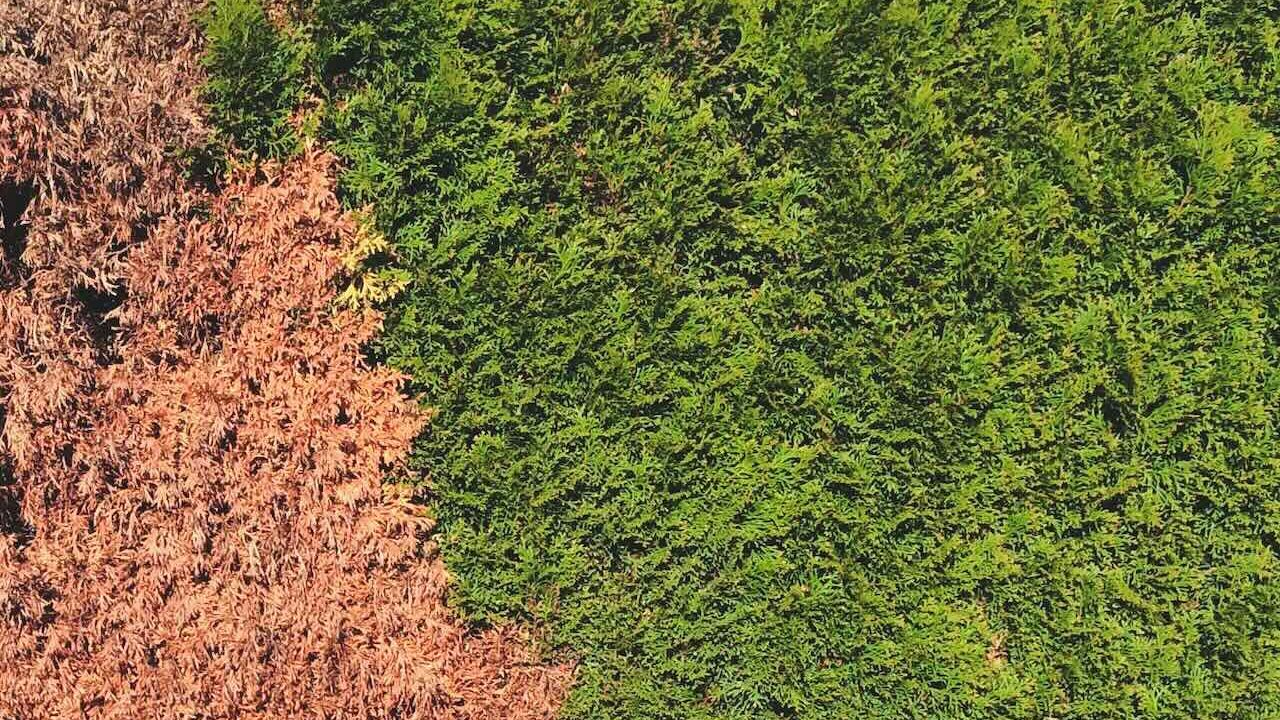
Root rot caused by excessively wet soil accounts for approximately 60% of the dying conifer cases I investigate. The symptoms develop gradually at first, often beginning with a slight yellowing or dullness in the foliage that progresses to brown and then completely dead patches. Unlike pest damage which typically affects specific areas, root rot damage usually starts at the bottom of the plant and works upward as roots die progressively from the base up.
Identifying Waterlogging Damage
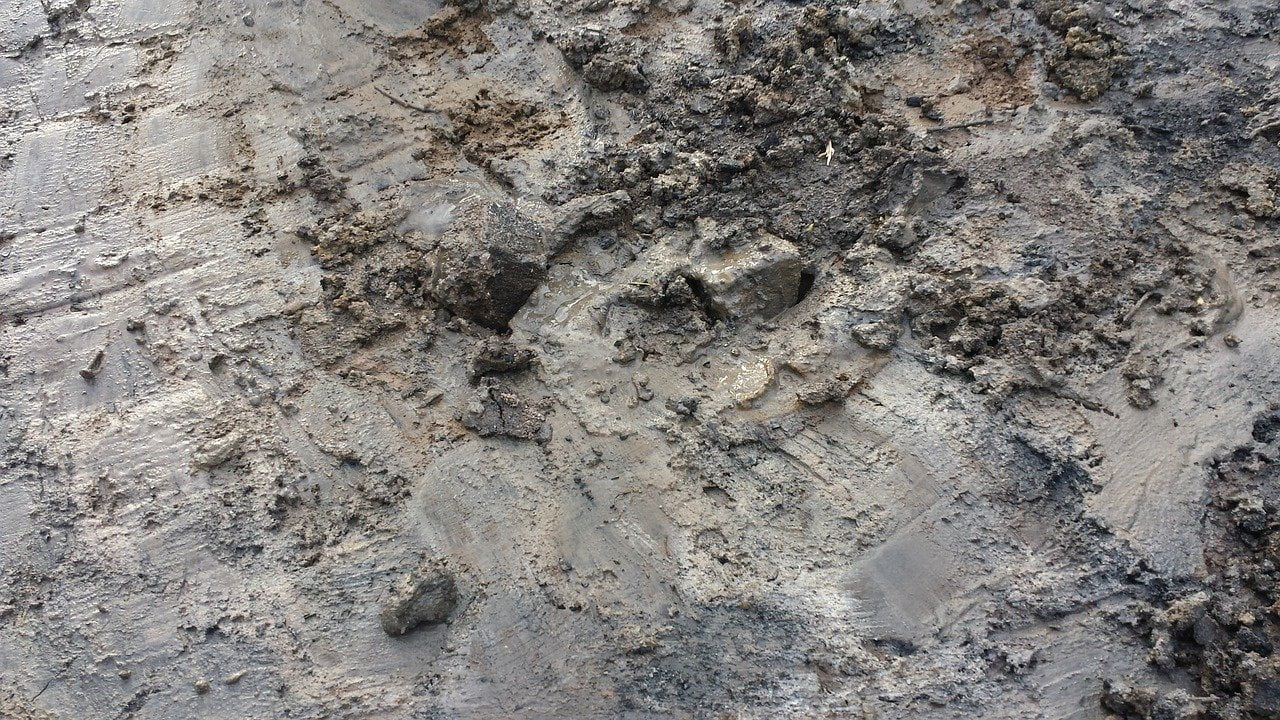
The key diagnostic clue is the soil condition. Push your finger deep into the soil around the conifer’s root zone. If it’s constantly sodden, remaining wet days after rain, or you can see standing water pooling around the base, you’ve identified your culprit. Heavy clay soils that drain poorly, low-lying areas where water collects, or over-enthusiastic watering during wet weather all create conditions where conifer roots literally drown from lack of oxygen.
Why Conifers Are Particularly Vulnerable
Most garden conifers, including leylandii, thuja, and cypresses, have relatively shallow, fibrous root systems that spread laterally rather than growing deep tap roots. This adaptation works brilliantly in their native habitats where drainage is typically excellent, but in British clay soils or compacted urban gardens, these shallow roots sit in the waterlogged zone where oxygen cannot penetrate.
When roots remain waterlogged for extended periods, they cannot absorb oxygen needed for cellular function. The roots literally suffocate and begin to die. Dead roots then become infected with various soil-borne fungi, particularly Phytophthora species, which spread through the root system and up into the trunk, causing progressive die-back. Once Phytophthora establishes, there is no cure, only management to slow its spread.
Drainage Solutions That Actually Work
If you catch waterlogging early before severe root damage occurs, improving drainage can save your conifers. For existing plants showing early symptoms, dig trenches 30-40cm deep around the affected area, sloping away from the plants to create drainage pathways. These trenches can be filled with gravel to create French drains that carry water away from the root zone.
For new conifer plantings in heavy soil, raised planting is absolutely essential. Create berms or raised beds 30cm above the existing soil level, filling with a mixture of topsoil and coarse grit or perlite to ensure sharp drainage. Never plant conifers in low spots or areas where water pools during rain, regardless of how perfect the location seems aesthetically.
Soil amendment works to some degree but cannot overcome fundamentally poor drainage. Incorporating sharp sand and organic matter into planting holes helps, but in truly heavy clay, this creates a sump effect where water drains into the improved hole, then cannot escape through the surrounding clay. In such situations, raised planting or choosing different plants entirely becomes necessary.
3) Pest Problems Creating Brown Patches
Several species of aphids specifically target conifers, with the most damaging being the green spruce aphid and the juniper aphid. These tiny insects feed on sap, causing needles to yellow, brown, and eventually drop. The damage often appears as random patches of browning that spread gradually as the infestation grows, quite different from the uniform browning of root problems.
Conifer Aphid Infestations
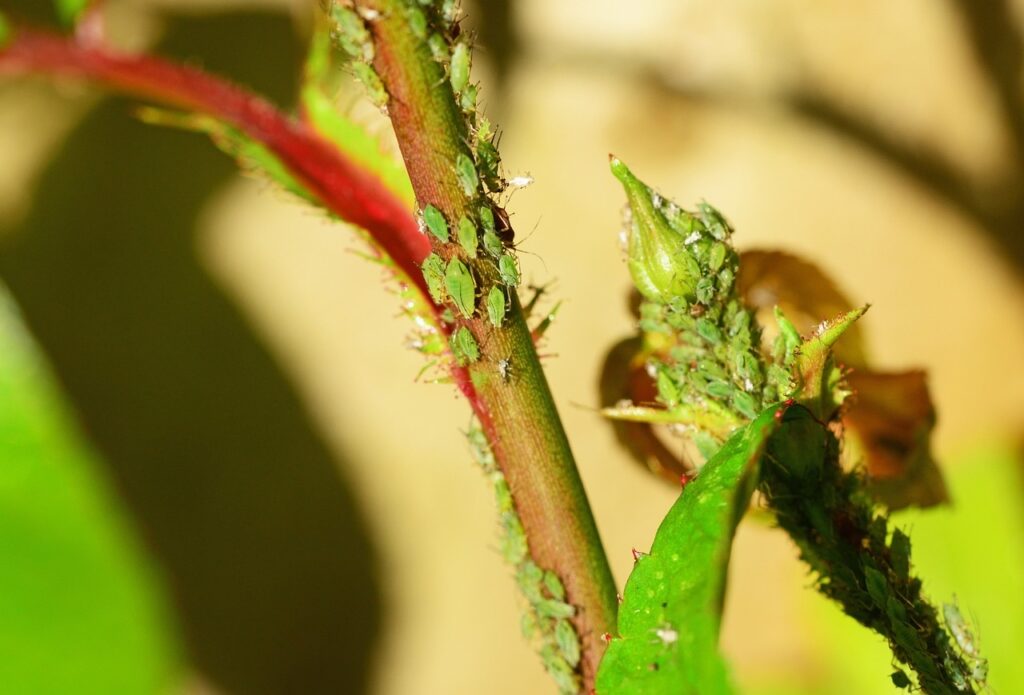
Look carefully at affected shoots with a magnifying glass. Aphids appear as small, soft-bodied insects clustered on needles and new growth. You might also see sticky honeydew coating needles or sooty mould growing on this honeydew deposit. The green spruce aphid is particularly problematic because it feeds during winter when most gardeners aren’t monitoring their conifers, causing significant damage before anyone notices. The below picture shows aphids on a rose which are easier to identify, but any similar insects on your conifer suggests aphid damage.
Treatment involves insecticidal soap or horticultural oil sprays applied thoroughly to affected areas. Winter treatment (December-February) for green spruce aphid is most effective, catching the population before spring breeding begins. For organic control, encouraging natural predators like ladybirds and lacewings helps maintain balance, though this takes time to establish.
Scale Insects and Their Distinctive Damage
Scale insects appear as small, immobile bumps on conifer stems and needles. Unlike aphids which move around, scales attach permanently and feed through the bark, causing progressive weakening. Heavy infestations result in yellowing, browning, and eventually death of affected branches.
Identification is straightforward once you know what to look for. Scratch a fingernail across a suspected scale. If it pops off, revealing a small insect body underneath, you’ve confirmed the diagnosis. The waxy coating scales produce makes them resistant to many insecticides, so treatment requires specific products containing acetamiprid or spirotetramat applied when young scales (crawlers) are active in late spring.
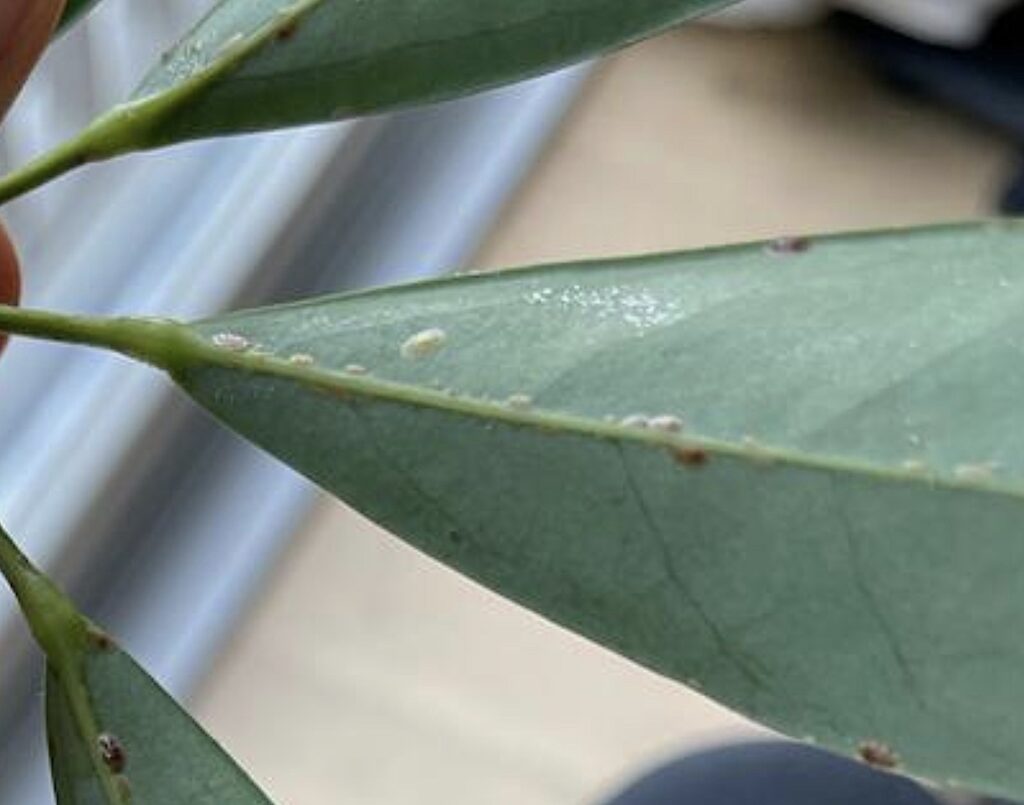
The below shows tiny scale insects on a house plant, theyare almost iompossible to see without a magnifying glass!
Conifer Mite Damage
Spider mites cause distinctive stippled yellowing that progresses to brown as damage accumulates. Hold white paper beneath affected branches and tap sharply. Tiny moving specks on the paper confirm mite presence. Hot, dry conditions favor mite populations, so they’re often worst during dry summers.
Regular forceful water spraying can control light infestations, washing mites off plants. For severe problems, specific miticides provide control, though organic options like predatory mites offer sustainable long-term management.
4) Fungal Diseases and Their Treatment
Various fungal diseases collectively called needle casts cause needles to yellow, brown, and fall prematurely. These diseases have specific seasonal cycles, often triggered by wet spring weather. Affected needles typically show characteristic banding or spotting before browning completely and dropping.
Needle Cast Diseases
I’ll be honest, Ninjas, by the time your confidence gets fungus, it’s nearly impossible to reverse. Which is why good plant hygiene is key, along with clean and correct pruning.
The key distinguishing feature of needle cast versus other problems is the pattern of needle drop. Infected needles fall cleanly from branches, leaving bare stems, whereas pest or drought damage typically leaves dead brown needles attached to branches. Fungal fruiting bodies may be visible as tiny black dots on infected needles.
Fungicides containing copper or mancozeb can prevent new infections when applied preventatively in spring, but they cannot reverse existing damage. Good sanitation such as removing and destroying fallen infected needles will reduce spore load and future infection risk. Improving air circulation through proper spacing and occasional thinning also helps.
Phytophthora Root Rot (The Death Sentence)
This soil-borne fungal disease causes progressive die-back starting from the base, with affected areas turning brown and dying while upper portions initially remain green. Unlike other problems that might affect random branches, Phytophthora creates a characteristic pattern where entire sections die from the bottom up or from one side progressively inward.
The brutal truth is that once Phytophthora establishes in conifers, there is no cure. The best approach focuses on prevention—improving drainage and avoiding waterlogging—and containment. Remove and destroy severely affected plants, including roots, to prevent spread to neighboring plants. Do not replant conifers in the same location without addressing drainage issues.
Environmental Stress Causing Browning
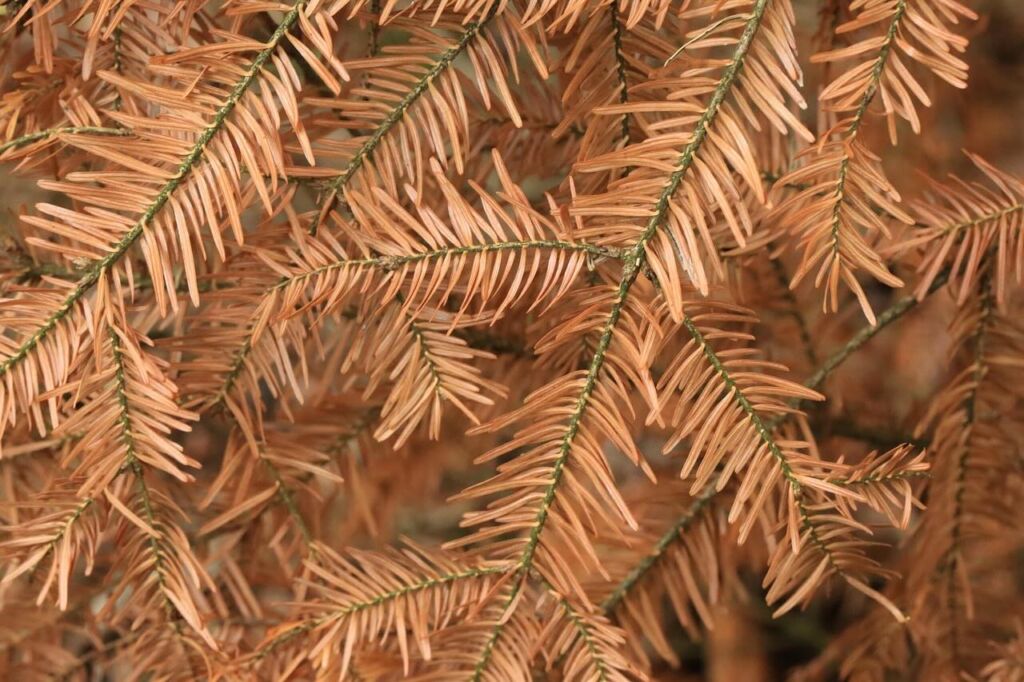
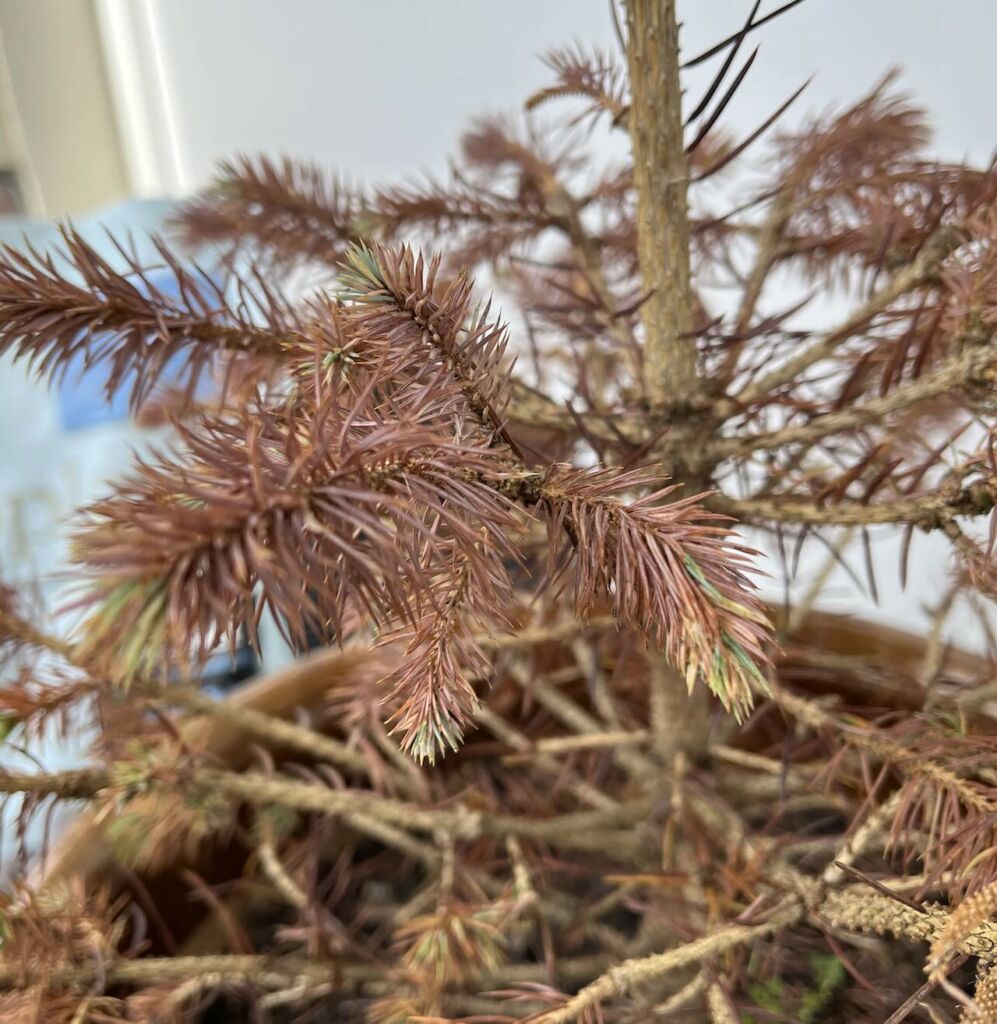
Drought damage typically appears as browning from the tips of branches inward, affecting the newest growth first. Unlike root rot, which browns from the base up, or pests, which create random patches, drought stress creates a distinctive pattern of tip dieback spreading toward the main trunk.
Drought Stress Recognition
During prolonged dry spells, even established conifers need supplemental watering. The shallow root systems of most garden conifers cannot access deep soil moisture, making them surprisingly vulnerable to drought despite their evergreen toughness. Newly planted conifers (less than 3 years established) are particularly vulnerable and need regular deep watering throughout their first several years.
Recovery from drought stress depends on severity. Mildly affected plants green up once regular moisture resumes, though the brown tips remain until pruned out. Severely drought-stressed conifers may not recover, having suffered irreversible cellular damage. Prevention through mulching and consistent watering during establishment proves far more effective than attempting to revive severely stressed plants.
Salt Damage from Winter De-icing
Conifers planted near roads or driveways where de-icing salt is applied show characteristic browning on the side facing the salt source. The damage appears in late winter or early spring as accumulated salts begin affecting plant tissues. Needles turn brown but typically remain attached, and damage is clearly worse on the salt-facing side.
Prevention involves creating physical barriers between salt application areas and valuable conifers, or choosing salt-tolerant species for roadside plantings. Once damage occurs, deep watering in spring helps leach accumulated salts below the root zone. Affected foliage will not recover and should be pruned out once new growth begins.
Species-Specific Vulnerabilities
Leylandii Hedge Problems
Leylandii (× Cuprocyparis leylandii) is notorious for browning problems, primarily because it’s often planted in completely unsuitable locations—heavy clay soil, waterlogged areas, or too close together creating poor air circulation. This fast-growing hedging plant needs excellent drainage and sufficient spacing to thrive.
Brown patches in leylandii hedges typically indicate either root rot from waterlogging, or pest problems like cypress aphid. The rapid growth rate means leylandii depletes soil nutrients quickly, so regular feeding helps maintain vigor and pest resistance. However, no amount of feeding can overcome fundamentally poor drainage.
Lawson Cypress Susceptibility
Lawson cypress (Chamaecyparis lawsoniana) is particularly prone to Phytophthora root rot, to the point where many professional landscapers now avoid specifying it entirely in heavy soils. If you’re planting Lawson cypress, absolutely perfect drainage is non-negotiable. Consider raised beds or extremely well-amended soil.
Thuja Resistance
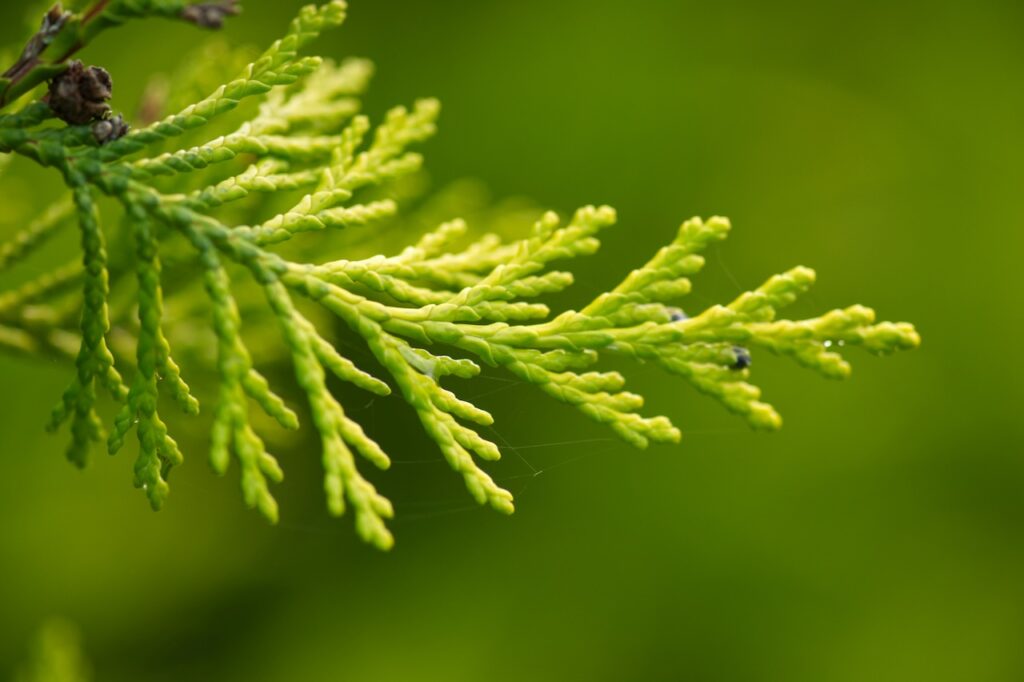
Western red cedar (Thuja plicata) shows better resistance to root rot than many alternatives, though it’s not immune. Thuja also handles rejuvenation pruning better than most conifers, making it a better choice where occasional trimming into old wood might be necessary.
Frequently Asked Questions
Can brown conifers turn green again?
No. Individual brown needles are dead and will not recover or turn green again. However, if the branches themselves remain alive (scratch the bark to check for green underneath), they can produce new green growth from dormant buds. Recovery depends on the extent and cause of browning.
Should I remove brown sections immediately?
Wait until spring before removing brown sections unless they’re obviously dead and detached. What appears completely dead in winter sometimes produces new growth from dormant buds in spring. However, clearly diseased material showing fungal growth should be removed promptly to prevent spread.
Will feeding help my dying conifer?
Not if the problem is root rot, disease, or pests. Feeding a dying conifer with root or disease problems is like force-feeding someone with food poisoning—it makes things worse. Address the underlying problem first. Only feed healthy conifers or those recovering from drought stress.
How can I prevent browning in new conifer plantings?
Ensure excellent drainage, plant at the correct depth (root flare visible), water consistently during establishment, apply mulch to conserve moisture and moderate soil temperature, and allow adequate spacing for air circulation. Most conifer problems are prevented through proper planting and site selection.
Are there any brown-resistant conifer alternatives?
No conifer is completely immune to all problems, but some show better overall resilience. Juniperus (junipers) handle drought well, Taxus (yew) tolerates shade and various conditions excellently, and Thuja plicata shows good disease resistance. Site conditions should drive species selection more than appearance alone.
Learn more about growing & Garden Design
Why not consider expanding your plant and garden design knowledge with one of my online gardening courses? My Garden Design for Beginners Course is here to help you transform your garden from average to exceptional with an affordable online course, no matter how little your experience with plants.
This course offers step-by-step guidance from me, Lee Burkhill, award-winning garden designer and presenter on BBC1’s Garden Rescue. In this course, you’ll go from a garden design novice to a confident designer equipped to tackle any green space.
Planting Techniques – Select and arrange plants like a pro.
Design Styles & Layout Options – Explore different styles to suit every garden.
Course Features:
20 Hours of Study Time
Flexible Online Learning
Engaging Video Lessons & Quizzes
Real-World Case Studies
Certification upon Completion
Taught by Award-Winning Designer Lee Burkhill
Enrol now for just £199 and start your journey toward garden design mastery!
29
Garden Design Examples for Small Gardens: 30 Design Templates & Planting Plans
Garden Design Examples for Small Gardens: 30 Design Templates & Planting Plans: In this online gardening course, I’ll walk you through 30 fantastic garden designs, explaining the logic behind the layout, the plant choices, and take-home tips for applying them in your own garden.
Weekend Garden Makeover: A Crash Course in Design for Beginners
Learn how to transform and design your own garden with Lee Burkhills crash course in garden design. Over 5 hours Lee will teach you how to design your own dream garden. Featuring practical design examples, planting ideas and video guides. Learn how to design your garden in one weekend!
Garden Design for Beginners: Create Your Dream Garden in Just 4 Weeks
Garden Design for Beginners Online Course: If you want to make the career jump to becoming a garden designer or to learn how to design your own garden, this is the beginner course for you. Join me, Lee Burkhill, an award-winning garden designer, as I train you in the art of beautiful garden design.
How to Prune Conifers: Ultimate Tree Care Guide – Complete guide covering when and how to trim conifers without causing browning, including tool selection and understanding apical dominance.
Garden Ninja Forum – Browse hundreds of real gardening questions and solutions from the Ninja community.
Lee Burkhill
Lee Burkhill, known as the Garden Ninja, is an award-winning garden designer and horticulturist with over 30 years of gardening experience and 15 years as a professional garden designer. A qualified RHS (Royal Horticultural Society) professional, Lee specialises in sustainable garden design and practical horticultural advice. He designs and presents on BBC1’s Garden Rescue and in leading gardening publications. Lee combines three decades of hands-on gardening knowledge with professional design qualifications to help gardeners create beautiful, functional outdoor spaces.